

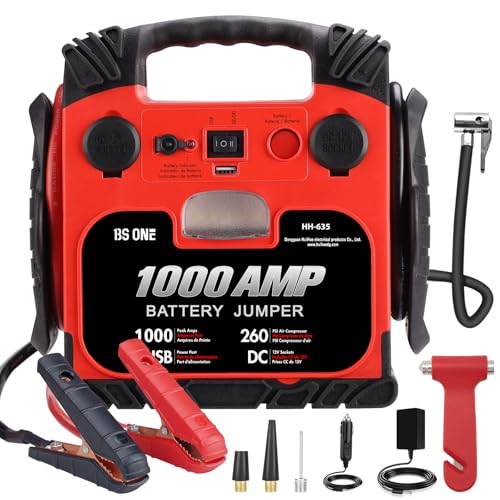
You turn the key, hear one tired click, and suddenly the grocery run has become a parking-lot project. Lead acid jump starters solve that by carrying their own 12V starting power instead of needing a second car. After comparing 6 models, the BS ONE 1000A Jump Starter with Air Compressor stands out for its 1,000-amp peak output, 260 PSI inflator and 9.9-pound weight. The STANLEY 1200A Jump Starter with Air Compressor is the alternative pick, with a 1,200-amp peak and 120 PSI inflator.
Pros
- 1000 amp peak current for 12V batteries
- 260 PSI air compressor with pressure gauge
- USB output rated 5V, 2.1A
- 12V/11A DC output for compatible devices
- Works from -4°F to 140°F
Cons
- 9.9 lb weight is bulkier than many pocket jump starters
- Lead-acid battery design adds size and weight
- No vehicle engine size limits are listed


Pros
- 1800 amps for 8.0L gas and 6.0L diesel engines
- 280 cranking amps and 225 cold cranking amps
- Works with standard, AGM, gel and deep cycle batteries
- 12V DC accessory outlet for powering devices
- Corrosion proof case and heavy gauge booster cables
Cons
- 17.5 lb weight may be bulky to carry
- Only a 12V DC accessory outlet is listed
- User manual is the only included accessory listed

Pros
- 1,700 peak amps and 425 cranking amps
- 68 inch 2 AWG welding cable leads
- Heavy duty Powerjaw clamps
- Built-in 3A automatic charger
- Master ON/OFF switch
Cons
- 23 pound weight is bulky to carry
- 22 x 18 x 9 inch size needs storage space
- No USB ports or air compressor listed

Pros
- 1600 peak amps for most 4, 6 and 8-cylinder vehicles
- 120 PSI digital inflator with automatic shutoff
- 25W USB-C and 15W USB-A charging ports
- Reverse-polarity protection warns of bad clamp connection
- Built-in LED area light for low-light roadside work
Cons
- 17.3 pounds is bulky for small storage spaces
- Extension cord for recharging is not included
- Inflator auto shutoff is limited to a 10-minute timer

Pros
- 1000 peak amps and 500 instant starting amps
- 120 PSI air compressor for low tires
- Reverse polarity alarm for improper connections
- USB port and 12V DC outlet for device power
- 270 degree rotating LED light
Cons
- 17.2 pounds, heavier than pocket jump starters
- Needs charging every 30 days when not in use
- Household extension cord is sold separately
What Matters in Lead Acid Jump Starters for Drivers
A lead-acid jump starter is usually larger than a pocket lithium pack, so the tradeoff is practical power versus the space it takes in a vehicle. The right pick should match the engine you drive, tolerate cold mornings, and keep clamp mistakes from becoming a bigger problem.
- Engine coverage: Output matters most when the battery is weak and the engine is reluctant to turn over. The Schumacher 1800A Jump Starter is the clearest high-output pick here, with 1,800 peak amps and coverage for engines up to 8L gas or 6L diesel. That makes it the one to consider first if you drive a larger truck, SUV or boat with a 12V battery. Its lead-acid battery also fits the category rather than crossing into lithium pack territory.
- Size and weight for vehicle storage: A jump starter that stays home because it is too bulky does not help in a store parking lot. The BS ONE 1000A Jump Starter with Air Compressor weighs 9.9 pounds, pairs a lead-acid battery with a 1,000-amp peak rating, and adds a 260 PSI inflator. That weight is less than half of the 23-pound lead-acid unit in this group, so it is easier to justify keeping in a trunk or cargo bin.
- Starts per charge and holding a charge: None of our listed picks state a specific number of starts per charge, so that claim was not used to rank them. We gave more weight to stated starting output, which ranges from 1,000 peak amps to 1,800 peak amps among the main picks. For storage, one listed model gives a concrete maintenance rule: charge it every 30 days when not in use. That is a useful reminder for any emergency battery pack that lives in a vehicle.
- Cold-weather operating range: Cold weather is where weak batteries often reveal themselves. According to AAA Oregon/Idaho, a car battery loses about 35 percent of its strength at 32°F and about 60 percent at 0°F. One of our picks states an operating range from -4°F to 140°F, which is the only listed temperature range in the group. That number matters because a cold engine may need up to twice the normal current to start.
- Safety protections in the clamps: Clamp safety is not a bonus feature when you are connecting directly to a vehicle battery. The Clore Jump-N-Carry JNC770R uses 68-inch 2 AWG cable leads and heavy-duty Powerjaw clamps, which should make reaching common battery locations easier than short clamp leads. It also has a master on/off switch, giving you one more control point before current flows. Other main picks include reverse-polarity warnings, which are important when the positive and negative clamps are easy to confuse in poor light.
- USB power bank output: USB ports are secondary to jump-starting, but they can keep a phone alive while you wait for help. Among the main picks, USB output ranges from a single 5V, 2.1A port to a 25W USB-C port. Another model has three USB-A ports rated at 3.1A and 15W. If phone charging matters to you, choose by the stated port type and wattage rather than assuming every jump starter charges devices at the same speed.
We excluded jumper cables because they require a second running vehicle, which is exactly what many roadside situations lack. We also left out trickle chargers and maintainers because they work over hours, not seconds. Commercial 24V semi truck boosters were excluded because they are built for heavier equipment and are more than most passenger-vehicle drivers need.
Other Jump Starters Worth Considering
These are other jump starters we looked at but did not put on our main list.
If you need both 12V and 24V modes, the Clore Jump-N-Carry JNC1224 is worth a look outside the main list. It has a 1,700-amp peak rating and a lead-acid battery, but its 40-pound weight is a major penalty next to our top pick at 9.9 pounds. That weight makes more sense for a shop than for a daily driver’s trunk.
For shoppers who want more peak output without moving into the 40-pound class, the DEWALT DXAEPS14 splits the difference. It offers 2,000 peak amps, a 120 PSI inflator and a 17.3-pound weight. That is still noticeably heavier than our top pick, but it may suit drivers who want an inflator and higher stated output in one unit.
At the heavy-duty end, the Schumacher 4400A Jump Starter is built around big numbers. It has a 4,400-amp peak rating, 12V and 24V modes, and a lead-acid battery. The tradeoff is its 41.23-pound weight, which is more than 4 times the weight of our top pick and likely too much for casual storage in a small car.
FAQs
Are lead acid jump starters better for cold weather?
Lead-acid models can be appealing for drivers who want a traditional sealed battery design, but the stated cold-weather range matters more than the chemistry label alone. Among our picks, one model lists operation from -4°F to 140°F, while several others do not publish a temperature range.
How many peak amps do I need in a lead acid jump starter?
Our main picks range from 1,000 peak amps to 1,800 peak amps. Larger gas and diesel engines generally call for the higher end, especially when the battery is weak or temperatures are near freezing.
Do lead acid jump starters need regular charging?
Yes, emergency jump starters should not be left untouched for long periods. One listed model specifies charging every 30 days when not in use, which is a practical schedule for keeping a stored unit ready.
Can I fly with a lead acid jump starter?
Airline rules are especially strict around lithium batteries and power banks, according to the Federal Aviation Administration. Lithium ion batteries are limited to 100 watt hours per battery, and spare lithium batteries must stay in the cabin, so check the exact battery type and airline rules before packing any jump starter.
Sources
- Winter Battery Preparation, AAA Oregon/Idaho. How cold weather drains car batteries and when to replace them.
- Whistler Recalls Jump&Go Portable Jumpstart and Power Supply Units, U.S. Consumer Product Safety Commission. Recall of a lithium jump starter that could overheat.
- PackSafe: Lithium Batteries, Federal Aviation Administration. Airline rules for carrying lithium batteries and power banks.



Write Your Review
No reviews yet. Be the first to share your experience!