

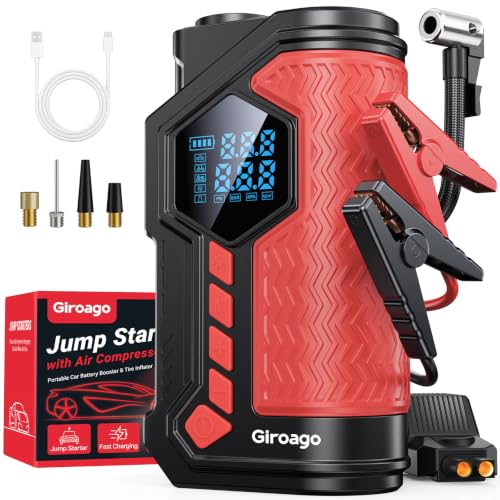
The battery always seems to quit when the coffee is still hot and the driveway is still dark. Mini jump starters solve that by putting a 12V boost in the glove box instead of asking a neighbor for cables. After comparing 6 models, the Giroago 6000A Jump Starter with Air Compressor leads with a 6,000-amp peak, support for 7L gas and 6L diesel engines, and a 150 PSI inflator. The SMENTJUMP 1500A Jump Starter is the alternative pick for 1,500-amp starting power.
Pros
- 6000A peak starting power for 12V batteries
- Rated for 7.0L gas and 6.0L diesel engines
- 150 PSI compressor with 35 L/min airflow
- 5 inflation modes with auto shutoff
- Spark proof clamps and reverse polarity protection
Cons
- Air pump should not be used continuously
- Suggested to start vehicle only above 75% charge
- Needs recharging every 2 to 3 months


Pros
- 5000A for up to 10.0L gas and 8.0L diesel engines
- 150 PSI inflator with auto stop and 4 pressure units
- Up to 50 jump starts on a full charge
- Works from -4°F to 140°F
- 10 built in safety protections with smart clamps
Cons
- Air compressor needs rest after 10 minutes of use
- Wall charger is not listed in the package
- Recommended to jump start only above 75% charge

Pros
- 5000A peak current rating
- Starts up to 9.0L gas and 8.5L diesel engines
- Works from -4°F to 140°F
- 12000mAh power bank with 2 USB output ports
- 10 safety protections with intelligent chip
Cons
- Needs at least 50% charge before jump starting
- Recharge every 3 months when stored
- No air compressor is listed


What We Looked For in Mini Jump Starters
A small jump starter still has to do a big job: deliver enough current to wake a weak 12V battery without turning the glove box into a tool drawer. The best fit depends on the engine you drive, how often you travel in cold weather, and whether you want the pack to double as emergency power.
- Engine coverage: Gas and diesel limits mattered more than peak amps alone, because a diesel engine typically asks more from a booster. The Giroago 6000A Jump Starter with Air Compressor pairs a 6,000-amp peak with coverage for engines up to 7L gas and 6L diesel. That gives it a practical edge for households with a sedan, SUV or light truck, and the 150 PSI inflator adds tire help without another powered tool.
- Size and weight for storage: A mini unit is only useful if it can stay in the vehicle without taking over the cargo area. Among our picks, the clearest weight figure is 0.71 pounds, which is light enough for a console, door pocket or small emergency pouch. The NACKEO 5000A Jump Starter (12,000 mAh) combines that weight with a 5,000-amp peak and coverage for 9L gas and 8.5L diesel engines.
- Starts per charge and holding a charge: Claimed starts per charge ranged from 35 to 50 among the models that give a number. The HPBS 5000A Jump Starter with Air Compressor is rated for up to 50 starts per charge, with a 5,000-amp peak and coverage for 10L gas and 8L diesel engines. For storage, the instructions across multiple packs call for recharging every 2 to 3 months, which is a useful habit for any lithium booster kept in a car.
- Cold-weather operating range: Cold starts deserve special attention because, according to AAA Oregon/Idaho, a car battery loses about 35 percent of its strength at 32°F. At 0°F, it loses about 60 percent of its power, and the engine may need up to twice the normal current to start. Among our picks, stated operating ranges include -4°F to 122°F and -4°F to 140°F, so the better fit depends on how severe your winters get.
- Safety protections in the clamps: Smart clamps are not a luxury when you are connecting power near a battery in the dark. Among our picks, several list 10 protections, including reverse-polarity, short-circuit and over-current protection. The U.S. Consumer Product Safety Commission has documented lithium jump starter risks, including a recall involving about 10,400 units and 45 overheating or melting reports, so clamp logic and battery safeguards matter.
- USB power bank output: Backup charging is secondary to starting a vehicle, but it can matter during a roadside wait. Among our picks, USB output figures include 5V/2.1A and 5V/3A, and battery capacity figures include 12,000 mAh. The Federal Aviation Administration notes that lithium ion batteries are limited to 100 Wh per battery for normal passenger carry, and spare power banks must stay in the cabin.
We excluded jumper cables because they need a second running vehicle, which is exactly what many roadside problems lack. We also left out trickle chargers and maintainers because they work over hours, not seconds, and skipped 24V semi truck boosters because they are built for commercial trucks and are heavier than most drivers need.
Other Jump Starters Worth Considering
These are other jump starters we looked at but did not put on our main list.
If peak current is the main draw, the fmooostore 8000A Jump Starter goes higher than our top pick, with an 8,000-amp peak instead of 6,000 amps. It also covers all gas engines and diesel engines up to 10L, which is more diesel capacity than most personal vehicles need.
For shoppers who want the same headline current as our top pick, the Sharmeal 6000A Jump Starter offers a 6,000-amp peak and covers all gas engines plus diesel engines up to 10L. It may appeal if engine coverage is the priority, though our main list puts more emphasis on the full emergency mix of starting, inflation and storage.
Prefer a pack that emphasizes repeated starts between charges? The OXILAM 6000A Jump Starter lists a 6,000-amp peak, diesel coverage up to 12L and up to 60 starts per charge. That start count is higher than the 50-start figure on one of our main picks, but it is still best judged against size, clamp protection and the rest of the kit.
And if lower output is enough for your vehicle, the Scatach 3000A Jump Starter lists a 3,000-amp peak and coverage up to 9L gas and 7L diesel. At 1.32 pounds and up to 50 starts per charge, it stays within the small-pack idea, though its peak rating is half of our top pick.
FAQs
How much power should a mini jump starter have?
Match the pack to your engine size first, then look at peak amps. Our picks cover gas engines from 7L to 10L and diesel engines from 5L to 8.5L, which is enough range for many cars, SUVs and light trucks.
Are mini jump starters useful in cold weather?
Yes, but cold weather makes the job harder. AAA Oregon/Idaho says a battery loses about 35 percent of its strength at 32°F, and at 0°F it loses about 60 percent of its power.
How often should a mini jump starter be recharged?
Several of our picks recommend topping off the pack every 2 to 3 months when it is stored. That schedule is especially sensible if the pack stays in a vehicle through temperature swings.
Can a mini jump starter charge a phone?
Many compact boosters double as USB power banks. Among our picks, listed USB outputs include 5V/2.1A and 5V/3A, and some packs list 12,000 mAh capacity for emergency device charging.
Sources
- Winter Battery Preparation, AAA Oregon/Idaho. How cold weather drains car batteries and when to replace them.
- Whistler Recalls Jump&Go Portable Jumpstart and Power Supply Units, U.S. Consumer Product Safety Commission. Recall of a lithium jump starter that could overheat.
- PackSafe: Lithium Batteries, Federal Aviation Administration. Airline rules for carrying lithium batteries and power banks.




Write Your Review
No reviews yet. Be the first to share your experience!