

Free Delivery. Exclusive Deals. All Prime.
Prime members save on shipping and get first access to deals, plus Prime Video included. 30 days free.
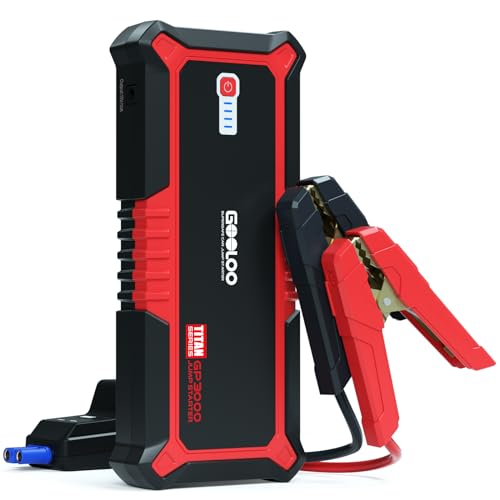
The battery dies right after you promised you would only be two minutes in the grocery store. Jump starters solve that problem by giving a 12V battery its own boost without waiting for another car. After comparing 6 models, the NOCO Boost GB40 is our top pick for its 1000-amp peak, up to 20 starts per charge and 2.5-pound body. The GOOLOO GP3000 is the alternative pick for its 3000-amp peak in a 1.39-pound pack.

Pros
- 1000A peak lithium power
- Up to 20 starts per charge
- Rated for up to 6.0L gas and 3.0L diesel engines
- Spark proof and reverse polarity protection
- 2.4 lb compact design
Cons
- No wall charger listed in the box
- No air compressor listed
- 1 year warranty
Pros
- 3000A peak output for 12V vehicles
- Starts up to 9.0L gas or 7.0L diesel engines
- Works from -4°F to 140°F
- 10 protections with spark-proof clamps
- 1.39 lb body, 8.97 x 3.92 x 1.29 inches
Cons
- Limited to 12V vehicle batteries
- Recharge every 90 days is recommended
- No air compressor included

Pros
- 4000A peak current for up to 10L gas or 10L diesel engines
- 160 PSI air compressor rated at 45 liters per minute
- 65W USB-C charging, full recharge in as fast as 2 hours
- 24,000 mAh power bank with USB-C, USB-A and DC outputs
- 400 lumen LED light with distress, strobe and high beam modes
Cons
- Charging adapter is not included
- For 12V vehicle batteries only
- Listed weight is 5.3 pounds

Pros
- 1,750 amps for gas up to 7.5L and diesel up to 5.0L
- Recharges in 1.2 hours via USB-C Power Delivery
- Up to 9 jump starts per charge
- 60W USB-C output charges phones, tablets, and laptops
- 200-lumen LED flashlight with 7 modes
Cons
- No air compressor listed
- Wall charger not listed in the box
- 3.37 lb weight may feel bulky in small glove boxes
Pros
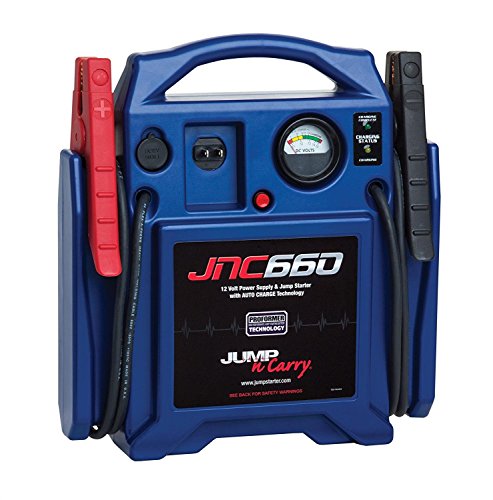
- 1700 peak amps
- 22Ah Clore Proformer battery
- 46 inch heavy-duty #2 AWG cables
- Voltmeter shows onboard battery charge
- DC outlet powers 12V accessories
Cons
- 18 pounds is heavier than compact jump starters
- 16.3 x 14.1 x 5.1 inch size takes storage space
- Engine size limits are not listed

Pros
- 2000 peak amps for most 4, 6 and 8-cylinder cars and trucks
- 120 PSI digital inflator with automatic shutoff
- 500W AC inverter for compatible small electronics
- 25W USB-C and 15W USB-A charging ports
- Reverse-polarity protection and LCD warnings
Cons
- 17.3 pounds, so it is heavier than pocket jump starters
- Limited to 12V WET, GEL and AGM lead-acid vehicle batteries
- 500W inverter is for compatible small electronics only
How We Chose Jump Starters for Most Drivers
A jump starter has to match the vehicle first, then fit the way it will be stored. Cold weather, infrequent driving and larger engines all make the numbers matter more than the accessory list.
- Matching the unit to engine size: Gas and diesel limits were the first cut because a compact sedan and a pickup do not ask the same thing from a booster. Among our picks, gas-engine coverage runs from 6.0L to 10L, while diesel coverage runs from 3.0L to 10L. A driver with a midsize crossover can choose a smaller pack, while a heavy-duty pickup owner should look near the top of those ranges.
- Battery type: Lithium packs are easier to carry, while a lead-acid box can make sense in a garage or service bay. The Clore Jump-N-Carry JNC660 uses a 22Ah battery and 46-inch #2 AWG cables, which is more like a traditional shop booster than a glove-box pack. Its 18-pound weight also makes it better for a shelf or trunk than for carrying in a backpack.
- Starts per charge and recharge time: Starts per charge matter if a pack is left in a car for emergencies, and recharge time matters when it doubles as a travel power bank. One of our compact picks lists up to 20 starts per charge, while another lists up to 9. The NOCO Boost GBX55 is rated at 1,750 amps for engines up to 7.5L gas and 5.0L diesel, and it recharges in 1.2 hours over USB-C.
- Extra tools: Some drivers only need a battery boost, while others want one roadside unit for tires and outlets too. The DEWALT DXAEPS14 combines 2000 peak amps with a 120 PSI inflator and a 500W AC inverter. At 17.3 pounds, it is closer to a trunk tool than a small lithium pack.
- Safety protections: Spark-proof clamps and reverse-polarity alerts reduce the chance of a bad connection when the hood is up in the dark. Among our picks, multiple models list reverse-polarity protection, and several include spark-proof clamp designs. The U.S. Consumer Product Safety Commission has documented lithium jump starter overheating risks, including a recall involving about 10,400 units, so protection circuits are not just convenience features.
- Weight and storage: The easiest unit to keep charged is the one that actually stays in the vehicle. Our picks range from 1.39 pounds to 18 pounds, which separates glove-box lithium packs from lead-acid boxes and compressor combos. The Federal Aviation Administration also limits lithium ion batteries to 100 watt hours per battery for routine airline carry, so check Wh ratings before flying with a pack.
We excluded jumper cables because they need a second running vehicle, trickle chargers and maintainers because they take hours to bring a battery back, and 24V semi truck boosters because they are heavy overkill for passenger vehicles. The main list focuses on 12V roadside help for ordinary cars, trucks, SUVs and home garages.
Other Jump Starters Worth Considering
These are other jump starters we looked at but did not put on our main list.
For a garage that wants an AGM jump box with a 12V outlet, Schumacher DSR119 is worth a look. It is rated at 1800 amps, with 280 cranking amps and 225 cold-cranking amps, and it covers engines up to 8.0L gas and 6.0L diesel. At 17.5 pounds, it sits close to the heavier lead-acid and combo units in our main list rather than the small lithium packs.
If tire inflation is part of the problem, AstroAI S8 Air adds a compressor without moving into large box territory. It has a 3000-amp peak and a 150 PSI inflator rated at 25 liters per minute. Its 2.43-pound weight is about half the weight of our air-compressor combo pick, but its inflator rating is lower than the 160 PSI unit on that main-list combo.
Prefer a light lithium pack with a screen you can read at a glance? HPBS H50 lists a 5000-amp peak, support for engines up to 10.0L gas and 8.0L diesel, and up to 40 starts. The 3.0-inch LCD and 1.21-pound weight are appealing on paper, but our alternative pick covers a similar job at 1.39 pounds with a 3000-amp peak.
And if peak amperage is the number that caught your eye, S ZEVZO ET03 claims 4000 amps in a 1.4-pound lithium pack. It is rated for engines up to 8.0L gas and 7.0L diesel, with a 74Wh battery. The reason it stays off the main list is simple: our alternative pick covers larger gas engines at a similar weight.
FAQs
How much starting power do most drivers need?
Match the jump starter to the engine size before looking at lights or ports. Our picks cover gas engines from 6.0L to 10L and diesel engines from 3.0L to 10L, so a commuter car can use a smaller pack while a truck may need the higher end of that range.
Is a lithium jump starter better than a lead-acid box?
Lithium packs are the better fit when weight and storage space matter, with our lightest main-list option at 1.39 pounds. Lead-acid boxes can still make sense for a garage, especially when long cables and a larger onboard battery are more useful than glove-box storage.
Do jump starters work well in cold weather?
Cold weather makes every start harder. According to AAA Oregon/Idaho, at 32°F a car battery loses about 35 percent of its strength, and at 0°F it loses about 60 percent of its power. AAA also says an engine may need up to twice the normal current to start in the cold.
Should I choose a jump starter with an air compressor?
Choose a compressor combo if tire pressure is a common roadside problem for you. Our compressor-equipped picks include ratings from 120 PSI to 160 PSI, but they also weigh more than the lightest lithium packs, so they make more sense in a trunk than a small console.
Sources
- Winter Battery Preparation, AAA Oregon/Idaho. How cold weather drains car batteries and when to replace them.
- Whistler Recalls Jump&Go Portable Jumpstart and Power Supply Units, U.S. Consumer Product Safety Commission. Recall of a lithium jump starter that could overheat.
- PackSafe: Lithium Batteries, Federal Aviation Administration. Airline rules for carrying lithium batteries and power banks.


Write Your Review
No reviews yet. Be the first to share your experience!