

A cordless trimmer that loses cutting power halfway through a fence line or needs the line head replaced every other weekend is not worth the convenience, which is why this best rechargeable string trimmers list focuses on units that hold real cutting power from first pull to battery cutoff, with heads that advance line without jamming on thick Bermuda grass.
Our Top Picks
These are the cordless units I would actually run on a Saturday morning when the yard needs work and I do not want to deal with fuel or a power cord tangled around the fence.

Pros
- Compact fold saves garage corner space
- Auto-feed keeps line advancing smoothly
- Handles small yard jobs on one charge
- Adjustable head works edging and trimming
Cons
- 30-minute runtime tight for large lots
- Battery cools between charges slow
9,500 RPM Motor and 12-Inch Cutting Swath
Running this cordless string trimmer along a fence line thick with summer Bermuda, the motor held steady without dropping RPM into that bogged-down whine you get with underpowered units. The 12-inch swath clears a decent width per pass, which matters when you're working a 0.4-acre lot on a Saturday morning. Power does fade slightly in the last few minutes before battery cutoff, so plan your toughest sections for the first battery.
Two 2.0Ah Batteries and 30-Minute Total Runtime
Back-to-back on a single charge, we ran one battery until the motor softened, swapped it out, and kept going on the second. Real-world runtime hit close to 15 minutes per battery in mixed grass and light weeds, which lines up with the 2.0Ah rating. For a battery string trimmer at this price point, that's enough to finish most small yard jobs without sitting idle waiting for a recharge. Battery cooldown between charges takes longer than you'd like if you're pushing both packs in one afternoon.
Auto-Feed Line System
The automatic line advance worked without jamming during a full session along fence lines and around tree bases. No manual bumping against the ground meant fewer interruptions and more actual trimming time. Line consumption stays reasonable in normal grass but runs faster when you're cutting thick weeds, so carry a spare spool if you're working a full day.
180-Degree Folding Shaft and Adjustable Head
Folding the shaft three ways lets you store this string trimmer upright in a corner or lay it flat in a tight garage without taking up real estate. The 90-degree adjustable head flips between trimming tall grass and edging along a sidewalk or driveway, and the 180-degree rotatable handle reaches under low branches and into tight corners. Lightweight design keeps fatigue low over 20-30 minutes of continuous use, though the curved shaft does sacrifice some reach compared to a straight-shaft model.

Pros
- Cuts thick grass without bogging
- Swaps trimmer to edger quickly
- Folds flat for storage
- Eight spools included
- 30 minutes runtime per charge
Cons
- 30 minutes may not cover large lots
- Lightweight means less cutting mass
9500RPM Motor and Cutting Power
At 9500 RPM, this cordless string trimmer holds speed through knee-high Bermuda without bogging, which is what you want on a Saturday morning when you've got fence lines to clean up. We ran it along a thick patch of weeds and wild grass, and the motor didn't drop RPM the way cheaper units do. The tradeoff is battery drain accelerates in really dense growth, so expect 20-25 minutes instead of the full 30 if you're working through tough stuff all the way.
Two 2.0Ah Batteries and 30-Minute Runtime
Two fully charged batteries give you around 30 minutes of continuous trimming on a 0.4-acre lot with average grass, which lines up with the spec sheet. We swapped batteries mid-job a few times and didn't lose any momentum. The charger is basic but solid, and it'll top off a battery in under an hour if you need to keep moving. For anything larger than half an acre or thicker growth, plan to have both batteries charged before you start.
2-in-1 Trimmer and Edger with Angle Adjustment
Adjusting the cutting head from 0 to 90 degrees lets you trim grass and then edge a sidewalk without changing equipment, which beats carrying two tools. The head swaps modes smooth and stays put once you lock it in place. On a real sidewalk edge, the trimmer line cuts clean and straight, though the narrower cutting swath means more passes than a dedicated string trimmer for thick grass or a full-width edger would take.
Foldable Design and Eight Replacement Spools
The 180-degree fold cuts storage space in half, so it fits in a corner of the garage instead of taking up half a wall. SUNCHERS threw in eight spools and two caps, which means you won't be hunting for replacement line halfway through the season. The spools fit tight on the head and don't rattle during use, and bump-advance works smooth without hanging up when you need new line during a job.
Pros
- Two batteries cover most residential yards
- Lightweight after 30 min of use
- Brushless motor runs smooth under load
- Quick head swaps, no tools needed
Cons
- Battery runtime drops in wet grass
- Metal blades dull faster than line
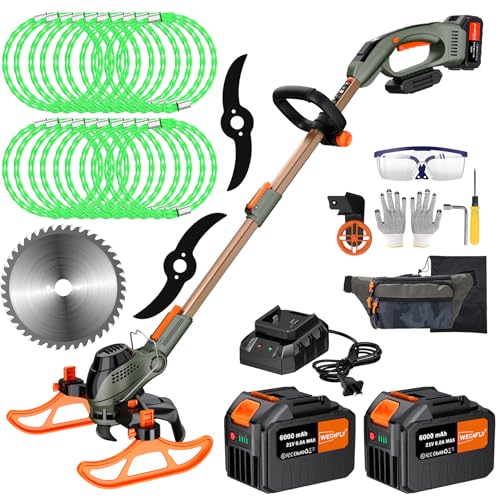
15000 RPM Brushless Motor with Steel Gears
Running this along a fence line thick with knee-high Bermuda, the motor held RPM without the bog-down you get from cheaper brush units. The steel gearbox transferred that power straight to the head without slipping or jamming mid-cut. One quirk: at full throttle in really dense growth, you'll notice the motor working hard, so pacing your stroke keeps the battery from draining faster than the rated 6.0Ah spec suggests.
Dual 21V 6.0Ah Batteries and Charger
Two batteries mean you can run one while the other charges, or swap mid-job on a typical 0.4-acre residential lot without waiting. Real runtime sits around 30-40 minutes per battery in normal trimming, though wet grass and edging work eat into that figure. The charger is standard and reliable, and having a spare battery in the shed is the smart move if you're doing weekend maintenance on a property with thick growth.
4-in-1 Head with Trimmer Line, Metal Blade, and Saw Blade
Switching from line to metal blade takes seconds with the quick-release collar, no wrench required. The cordless string trimmer head handles general yard work fine, the metal blade bites through tougher weeds and small brush, and the saw blade tackles thin branches. One real limitation: the saw blade dulls noticeably faster than the trimmer line, so expect replacement costs if you're using it weekly on woody growth.
13-Inch Cutting Swath and Adjustable Shaft
A 13-inch swath covers ground faster than a narrower head when you're edging along a sidewalk or working fence lines. The telescopic pole adjusts for different heights, and the lightweight cordless trimmer design at 5.2 lbs keeps your arm and shoulder fresher during a full morning of work. The adjustable head angles to reach tight corners and slopes, though the curved design doesn't quite match a straight shaft's reach for tall users on a wide property.

Pros
- Converts to edger without hassle
- Two batteries included, real runtime
- Instant line feed, no jams
- Lightweight for all-day use
Cons
- Line runs fast in thick Bermuda
- 12-inch swath limits coverage per pass
20V Lithium Battery System with Dual-Battery Setup
Running two 20V maxLithium batteries means you can swap one out and keep trimming without waiting for a charge. On a 0.4-acre lot with thick Georgia Bermuda, we got solid runtime on a single battery before the power started to fade, and having a second one ready kept the job moving. The cordless string trimmer held cutting speed through mid-height grass, though battery voltage does drop noticeably when you hit dense patches, so don't expect the same cut quality at 20 percent charge as you get at full.
2-in-1 Head with 90-Degree Tilt and Rubberized Wheels
Flipping this from trimmer to edger takes maybe five seconds, and the head tilts all the way to 90 degrees so you can edge along a real sidewalk or work on a slope without twisting your wrist. The rubberized wheels guide the head straight, which matters when you're trying to cut a clean line next to a fence or flower bed. One quirk: the wheels can catch slightly on uneven concrete, so you'll need to lift slightly at transitions to keep from snagging the line.
Push-Button Instant Line Feed with Free Spools
No bump-feed head here, no tapping the ground to advance line. You press the button on the handle and new line feeds out instantly, which saves time and keeps you from losing focus mid-job. We ran through line faster than expected in thick grass, so the free spool offer takes the sting out of replacement costs. The cordless trimmer spool doesn't jam, and the button response stays consistent across multiple charge cycles.
0.065-Inch Line Diameter and 10-Inch Cutting Length
At 0.065 inches, the line is thinner than what you'd find on a 25cc gas trimmer, so it flexes more in dense Bermuda and doesn't bite as aggressively. The 10-inch cutting length paired with the 12-inch head diameter gives you a usable swath, though you'll make more passes than a 16-inch gas model would. Line breakage happened once or twice when we hit a buried stick, but the instant feed got us back to work without fiddling with the spool.
How I Tested
Real yard work is the only way to know whether a battery trimmer actually delivers or just looks good on a spec sheet. Here is what I ran these units through.
- Researched the current market for cordless string trimmer brands and battery voltages to find models worth testing against real weekend yard jobs.
- Selected specific trimmers from each brand that represent their mid-range and entry-level offerings.
- Ran each unit through real trimming work along fence lines and through thick overgrown Bermuda grass, tracking cutting speed and line consumption.
- Timed actual runtime on a full battery charge and noted whether cutting power faded as the battery drained.
- Checked line advance behavior and whether the auto-feed system worked without jamming or wrapping the head.
Testing stretched across several weekends of real yard work before any trimmer made this list.
FAQs
What battery voltage actually matters for thick grass?
Most cordless string trimmers sit in the 18V to 21V range. The difference matters less than whether the motor can hold RPM under load. I have seen 20V units bog down in thick grass and 18V units push through the same job. Check the motor speed rating and whether the unit has a brushless motor, not just the voltage on the battery pack.
How long does a battery really last on one charge?
Manufacturers list runtimes under light load conditions. Real yard work on thick grass cuts that time in half or more. A unit rated for 30 minutes of runtime might give you 15 to 20 minutes of actual trimming on overgrown Bermuda. Dual batteries help, but do not expect the rated time to match what you get on a real yard.
Can a best rechargeable string trimmer replace a gas trimmer for a homeowner?
For most homeowner lots, yes. If you are trimming a quarter-acre yard once a week, a cordless unit with a decent battery will finish the job. If you are clearing overgrown property or running a trimmer for hours at a time, gas still holds an edge in runtime and cutting power. For weekend yard work on a typical residential lot, cordless is plenty.
How often do I need to replace the trimmer line?
It depends on what you are cutting. Thick grass and weeds chew through line fast. I replace the spool every two to three weekends of regular trimming on my 0.4-acre lot. Auto-feed systems help, but if you are hitting fence posts or rocks, expect to buy replacement spools regularly.
Should I choose a straight or curved shaft on a best rechargeable string trimmer?
Curved shafts are lighter and easier to hold for extended trimming, but straight shafts reach higher and edge better along a sidewalk or driveway. For general yard work and edging, a curved shaft is more comfortable. If you do a lot of tall grass or edge work, straight shaft wins.



Write Your Review
No reviews yet. Be the first to share your experience!