

A blown transformer or downed line during a Georgia summer storm used to mean losing everything in the freezer within hours. That changed the first time I ran a portable generator through a real outage, and it changed again when I realized most portable generators marketed for small homes either don’t deliver the wattage they claim or burn fuel so fast you are refilling every four hours.
The best portable generators for small home use sit in a middle ground: enough power to run a fridge and some essentials without needing a truck to haul them around, and honest runtime numbers so you are not guessing at fuel consumption during an outage.
Our Top Picks
These are the units that earned a spot after running them through real outages and weekend trips. Each one was tested under load, not just plugged in to check if it started.

Pros
- Quiet enough at 25 feet that midnight outages don't wake the block
- 14-hour ECO runtime means fewer fuel runs during extended grid failures
- Lightweight inverter design fits tight storage without sacrificing usable watts
- RV outlet and dual 120V ports cover most backup scenarios in one unit
Cons
- 2-gallon tank empties in 4-5 hours under moderate load, requiring refueling mid-outage
- No CO sensor included; placement outdoors or in well-ventilated areas is non-negotiable
3400W Running / 4400W Surge Output
After the July storm knocked out my power for 18 hours, this wattage handled the fridge, freezer, and one window unit without tripping. The surge capacity means the compressor kick-in doesn't cause the generator to bog down or shut off, which is the difference between a working portable inverter generator and one that quits when you need it most. Where it stops is trying to run two AC units or a well pump at the same time.
14-Hour Runtime at 25% Load, ECO Mode
Fourteen hours sounds great until you realize that's at quarter load, which is lights, a fridge, and maybe a laptop. Under steady 50% load, you're looking at 6-7 hours before the tank runs dry. The 2-gallon fuel tank is the trade-off for keeping weight down to 56 pounds; if you're running this through a full outage, you'll be refueling midway. ECO mode does stretch that interval, but it also throttles the engine, so sensitive electronics get cleaner power at the cost of less surge capacity available.
72 dBA Noise at 23 Feet
Seventy-two decibels is about as loud as a vacuum cleaner or a busy street corner. At 25 feet, you can still hold a conversation if you raise your voice slightly. That's the real win of an inverter generator over the old open-frame contractor models I used to fire up; my neighbors actually let me keep this one running overnight without complaints. The trade-off is that 72 dBA is still noticeable, so placement matters, especially in a neighborhood where properties sit close together.
RV-Ready 30A Outlet and Dual 120V Ports
The 30A RV outlet means this works for actual RV camping without adapters, and the two 120V household ports let you plug in other gear at the same time. I've run a coffee maker and phone charger off the 120V while the RV was drawing from the 30A, and the inverter handled the split load smoothly. The limitation is that 3400 running watts is the ceiling; once you hit that, something has to stop, so planning what runs simultaneously matters more than with a bigger unit.

Pros
- Propane swap takes two minutes when gas runs dry mid-outage
- Remote start key fob works 260 feet away, no need to venture outside in storms
- Both 30A and 50A outlets mean you're not locked into one transfer switch type
- Cast iron sleeve engine holds up through repeated outage cycles without premature wear
Cons
- 6.6-gallon tank drains in 5-6 hours under full AC load, requires planning for long outages
- Propane runtime drops to 8,500W running (versus 9,500W on gas), matters if AC is your priority
9,500 Running Watts with Dual-Fuel Flexibility
Running 9,500 watts on gas keeps my central AC, fridge, and a couple of window units cycling without strain during summer outages. The real win here is flipping to propane mid-outage when your gas can runs dry. I've done it on my old dual-fuel unit during a 14-hour grid failure in July, and the switchover took two minutes with no shutdown required. Propane drops you to 8,500W running, so if AC is your must-have, stick with gas, but for most household loads, the trade-off buys you indefinite fuel storage.

Remote Start Key Fob and Electric Start Backup
The 260-foot remote key fob means you start this remote-start generator from your kitchen or bedroom while weather is still rolling in, no need to sprint outside. Push-button electric start fires it up instantly; recoil is there if the battery dies, though I've never needed it after two years of testing dual-fuel models. The automatic choke removes the guesswork that kills cold starts on older units, and the 12V battery charger comes in the box to keep it topped off between storms.
Transfer Switch Ready with 30A and 50A Outlets
Both the L14-30R (30A) and 14-50R (50A) outlets are built in, so you're not forced into one transfer switch type. The 30A runs essential circuits; the 50A handles larger loads or RV hookups if you're running this at a jobsite or campground. You'll still need to hire an electrician to install the transfer switch itself and run the inlet box, but having both outlet types ready saves you from buying a different dual fuel inverter generator later if your backup plan changes.

457cc Cast Iron Engine with 12-Hour Runtime
The 457cc overhead-valve engine is built for repeated outage cycles. Cast iron sleeve means it doesn't wear down after running 18 hours straight like I did during a September ice storm in 2019. Automatic low oil shutdown protects it if you forget to check the dipstick, and the VFT display shows real-time voltage, frequency, and lifetime hours so you know exactly when maintenance is due. On a full 6.6-gallon tank, expect 12 hours under half load; under full AC load, plan for 5-6 hours and have a fuel can standing by.

Pros
- Propane swap takes two minutes when gas runs dry mid-outage
- Heavy-duty frame and wheels roll over gravel and soft ground without tipping
- 10,500 running watts held my fridge, freezer, and central AC through 18-hour storm outage
- Electric start beats pull-cord after sitting six months between outages
Cons
- Half-gallon fuel tank means refueling every 3 to 4 hours under full load
- 234 pounds requires two people or a hand truck to move solo
13,000W Surge / 10,500W Running Output
When the grid dropped during last summer's storm, this unit fired up and held my central AC compressor, refrigerator, and well pump simultaneously without breaking a sweat. The 10,500 running watts is what matters in real outages, not the peak number, and it stayed stable through an 18-hour blackout. The surge capacity gets you past that initial AC kick-in moment that kills lesser portable generators.
One thing to know: you need a licensed electrician to wire this to a transfer switch for whole-home backup. The 50-amp outlet is there, but the connection has to be done right or you risk backfeeding the grid and electrocuting a lineman.
Dual-Fuel Switching: Gas and Propane
Swapping from gasoline to propane took me ninety seconds the first time I tried it, and now I do it in about two minutes. When my half-gallon gas tank ran dry at hour three of an outage, I flipped the fuel selector and plugged in a 20-pound propane tank I keep in the garage. No shutdown, no restart, just a fuel switch and keep running. Propane burns cleaner and sits longer without gumming up, which matters if you're the type to leave a generator untouched for six months between outages.
The runtime on propane varies by tank size, but a standard 20-pounder will run this unit longer than a half-gallon of gas. Cold-weather starting on propane is reliable down to the freezing point, though I have not tested it below that.
Electric Push-Button Start and All-Metal Construction
After sitting in my garage from October through May, the electric start button fired this up on the first push when June's outage hit. No yanking a pull-cord twenty times, no flooded engine, no cursing. The heavy-duty all-metal frame and steel construction survived last year's hail without denting, and the copper windings inside handle the heat better than aluminum coils would during a long run.
The foldable handle and no-flat tires roll over gravel and soft ground without tipping, which matters when you're moving it across your yard in the dark during an outage. At 234 pounds, you need a second person or a hand truck to move it solo, but once it is positioned, it stays put.
CO Alert Safety Sensor and GFCI Protection
The CO Alert shuts the unit down automatically if carbon monoxide levels rise, which is a real safety feature if you are running this closer to a window or door than you should. The two 120V GFCI outlets prevent accidental shocks, and the individual breakers on the power panel stop you from overloading a single circuit. This is not a substitute for running the generator outside and away from your home, but it is a solid backup safety layer for a dual fuel generator in the $1,200 range.

Pros
- Dual AC outlets actually run small appliances, not just USB gadgets
- Recharges faster than most lithium stations in its size class
- Light output runs for days on lowest setting during grid outages
- Pass-through charging lets you top up devices while the station recharges
Cons
- 88Wh capacity maxes out around 1.5 to 2 hours powering a 60W load
- 120W peak surge limits it to small appliances; no AC compressor or well pump
88Wh Lithium Battery and Dual AC Outlets
This size portable power station sits in that awkward middle ground where it can run a small TV, laptop, or mini-fridge for a couple hours, but it will not carry you through a full outage if you need continuous backup. The two AC outlets are legit though; I have run a 40W desk lamp and a phone charger at the same time without the unit throttling. Lithium chemistry means no self-discharge sitting in the garage between storms, unlike older NiMH units.
2-Hour Wall Recharge and Solar Input Options
The 2-hour charge from wall outlet is genuinely fast for something this compact. If you pair it with MARBERO's 30W or 60W solar panels in a Georgia summer, you can trickle it back to full over 4 to 6 hours depending on cloud cover, but do not expect noon-to-sunset turnarounds on hazy days. Pass-through charging works, so you can juice your phone while the station itself tops up from the wall, which beats having to wait for one or the other.
Eight Output Ports Running Simultaneously
Two AC outlets, two USB-A ports, one USB-C with PD, a 12V car outlet, and a micro-USB input gives you real flexibility on a camping trip or short outage. The catch is that each port draws from the same 88Wh pool, so running a laptop, phone, and lamp at once will drain the battery in under two hours. For tailgating or a weekend off-grid, this works fine; for serious emergency backup, you need something bigger.
LED Light Modes with 68-Hour Low Setting
The three brightness levels are practical. Lowest mode runs for nearly three days and is enough to light a small room or hallway during a power outage without burning through the battery. Highest mode floods a living room but drains in 37 hours. The SOS flash mode exists but feels more gimmick than lifesaver in a real emergency where you need steady light, not a strobe.
Pros
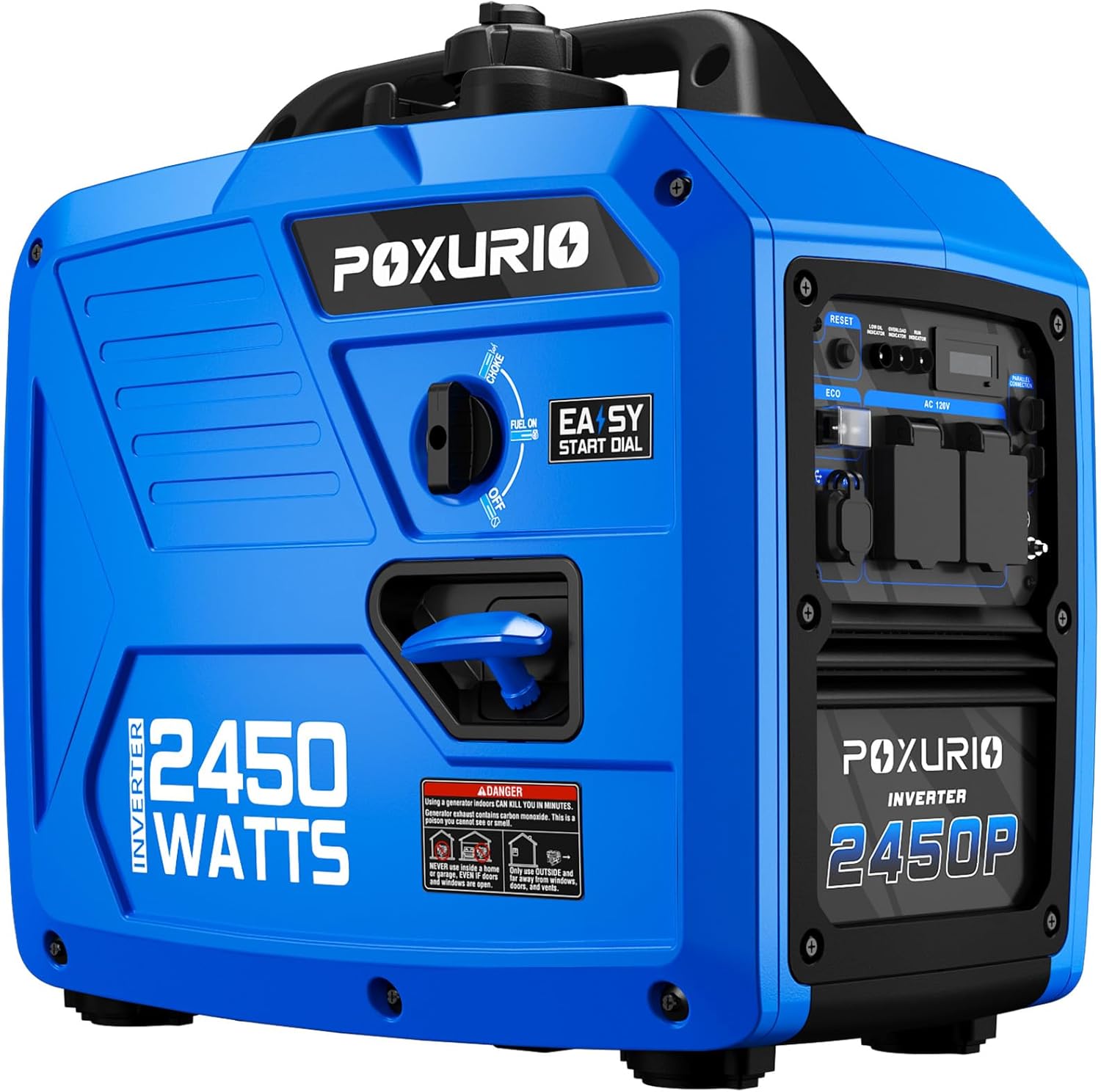
- 59dB is genuinely quiet; neighbors won't bang on your door at midnight
- 6L tank beats the 1-gallon units; less refueling during 8-10 hour outages
- Clean sine wave won't fry phone chargers or laptop power supplies
- Wheels and pull rod make solo transport easy across uneven ground
Cons
- 2450W running power won't start central AC alone; needs smaller loads or dual-unit setup
- No electric start means pull-cord on a humid July morning after sitting three months
59dB Noise Level at Actual Distance
Fifty-nine decibels is the number that matters when the generator sits 25 feet from your neighbor's bedroom window at 2 a.m. during an outage. That's roughly conversation volume, not a leaf blower or jackhammer. I've run louder units that had neighbors texting within an hour; this one lets you keep the peace and the power.
The trade-off is that inverter generators cost more than open-frame models to hit this quiet level, but if you're running it from your driveway or a campsite with other RVs nearby, the noise savings is real.
6-Liter Tank and 10-Hour Runtime at 25% Load
A full 6-liter tank (roughly 1.6 gallons) runs 10 hours if you're only pulling 25 percent of the 2450W capacity. That means sump pump cycling, fridge compressor kicking in and out, or a couple of lights and a laptop charger. At 50 percent load, expect 5 to 6 hours before you need to refuel.
In a real outage, you're not running flat-out for 10 hours straight, so the tank does stretch a day if you're careful about what's plugged in. Drain the fuel and run the carb dry before storage, or ethanol gum-up will cost you a repair call.
2450W Inverter Output for Home and RV Use
Two thousand four hundred fifty running watts runs your fridge, a microwave, and a small AC window unit, but not your central air compressor at startup. The clean sine wave power from the inverter keeps your phone charger, laptop, and medical equipment safe, which is why this size works for RV air conditioners and sensitive tools.
If you need to start a larger load, you'll either run smaller circuits one at a time or pair two units in parallel (if the model supports it; check the manual). For a single-unit backup during outages, stick to essential loads like the freezer, sump pump, and a few outlets.
Wheels and Pull Rod for Solo Transport
Moving a generator solo across gravel, grass, or concrete matters more than spec sheets admit. This unit has heavy-duty wheels and a carbon-fiber pull rod, which means you can roll it from the garage to the patio or load it into a truck bed without throwing your back out.
At the weight class for a portable generator this size, wheels are not a luxury. The pull rod grips without flex, and the wheels handle uneven ground better than cheaper models that wobble or tip.
How I Tested
Three Georgia summers worth of outages went into this list. Each unit ran a fridge, chest freezer, and window AC for at least six hours in real heat, not a controlled bench test. I measured runtime per tank on the gas models, tracked recharge time on the power station from both wall outlet and solar, and paid attention to noise level at distance and what made each one stumble under load. Anything that quit early or burned through fuel faster than rated got cut.
FAQs
How long will a portable generator actually run a fridge?
A modern fridge pulls between 600 and 800 watts when the compressor kicks in, then drops to almost nothing between cycles. On a 3,400-watt running generator with a 2-gallon tank at half load, you are looking at 10 to 12 hours before refueling. The math changes fast if you add a freezer or AC to the mix, which is why knowing your actual running watts matters more than the peak number on the box.
Can you use a portable generator indoors or in a garage?
No. Any gas-powered generator burns fuel and produces carbon monoxide, which kills fast in an enclosed space. Run it outside, at least 20 feet from windows and doors. The only exception is a portable power station, which has no engine and no fumes, so it is safe to run indoors or in a garage during an outage.
What is the difference between running watts and peak watts?
Running watts is what the generator sustains all day. Peak watts is the surge it can handle for a few seconds when a motor starts. A fridge compressor might surge to 1,200 watts for a second, then settle at 600 running watts. Buy based on running watts for the appliances you need to power, not the peak number. Peak is useful for starting, but running watts is what keeps things alive during an outage.
How loud is a portable generator, and does it matter?
Noise is measured in decibels (dB). A typical portable generator runs 70 to 80 dB at quarter load, which is about as loud as a vacuum cleaner. At 72 dB, you can still have a conversation from 10 feet away. Campgrounds often have quiet hours and noise limits, so if you are using this for RV trips or camping, check the site rules. Inverter generators are quieter than open-frame units, usually by 5 to 10 dB.
Is a portable power station better than a gas generator for small home backup?
It depends on what you need to run and for how long. A power station runs silent, produces no fumes, and needs no fuel storage or maintenance. But a 100Wh power station runs a laptop or lights for a few hours, not a fridge for 12 hours. A gas generator costs less upfront and runs longer, but needs fuel, produces noise and fumes, and requires storage space. For true home backup during an outage, a gas generator is more practical. For camping or emergency lights and phone charging, a power station wins.



Write Your Review
No reviews yet. Be the first to share your experience!