

Try Amazon Prime free for 30 days
Fast free delivery on heavy items, plus Prime Video, Prime Music and member-only deal prices.
Electric start on a portable generator sounds like a luxury until you are standing in the dark after an outage and do not want to yank a pull cord. Best electric start portable generators cut that frustration out—you turn a key or push a button and the engine fires. I have owned both pull-cord and electric start units, and after running them through Georgia summer storms that knock power for 12+ hours, the electric start wins every time.
The catch is picking one that actually delivers on runtime, handles the loads you need (fridge, AC, well pump), and does not die after a season of storage. Below is what I would buy if I were shopping today.
My Top Picks
These are the units I keep coming back to. Each one was tested under real load during outages, not just plugged in to a lamp in the driveway.

Pros
- Quiet enough for backyard use without angering neighbors or wildlife at night
- Electric start eliminates the pull-cord struggle on cold mornings or restarts
- Clean sine wave output safe for laptops, chargers, and sensitive electronics
- 3800W continuous output carries most home backup loads without overload trips
Cons
- 3.4-gallon tank requires refueling every 5 hours at full load during longer outages
- 3800W running watts won't start large central AC units or well pumps solo
4800W Surge / 3800W Running Output and Real Load Limits
The jump from 3800W continuous to 4800W surge sounds bigger on paper than it plays out in the garage. That surge handles the compressor kick on a window AC or fridge startup, but it does not hold for long. I ran this through a 16-hour July outage last summer keeping the kitchen fridge, a couple of box fans, and phone chargers alive without a hiccup. The inverter generator held steady the whole time. Where it stops is anything that demands sustained draw above 3800W, like a central AC unit or well pump, which will trip the overload protection and leave you sitting in the dark.
67dB at Full Load and What That Means at Your Property Line
Sixty-seven decibels at 23 feet sounds like a spec until you actually stand there. I set this up during a test run on a Saturday afternoon, and my neighbor two properties over did not even step outside to ask what the noise was. That is the difference between an inverter generator with a fully enclosed body and the open-frame contractor rig I had before, which sounded like an angry lawnmower at the same distance. The eco mode throttles it down further, though you trade some output for the quiet. For camping or tailgating, this noise level means you can run it through the evening without becoming the site everyone glares at.
3.4-Gallon Tank and the Refuel Reality During Extended Outages
The fuel tank holds 3.43 gallons, which gives you 10 hours at 50 percent load before the gauge hits empty. That sounds fine until a storm knocks your power out for 18 hours and you are rationing fuel between the fridge, a fan, and the well pump. At full load, you are looking at 5 hours before refueling. I keep a spare 5-gallon can in the garage for this reason, and I learned early that ethanol gas gums up the carburetor if the unit sits for more than a month without stabilizer. The auto-throttle feature helps stretch runtime in eco mode, but do not count on it to cover a full day without a fill-up.
Electric Start and the 30A RV Outlet for Backup or Camping
Pressing a button instead of yanking a cord never gets old, especially when you are tired after an outage or standing in the cold at a tailgate. The electric start fires on the first push every time I have used it, and there is no pull-cord arm strain at the end of a long day. The 30A RV outlet is real and handles full-size trailers without stepping down to 20A household circuits. Two standard 120V outlets plus USB ports give you flexibility for mixed loads, though the parallel-ready design means if you need more than 3800W continuous, you are buying a second unit, not upgrading to one.
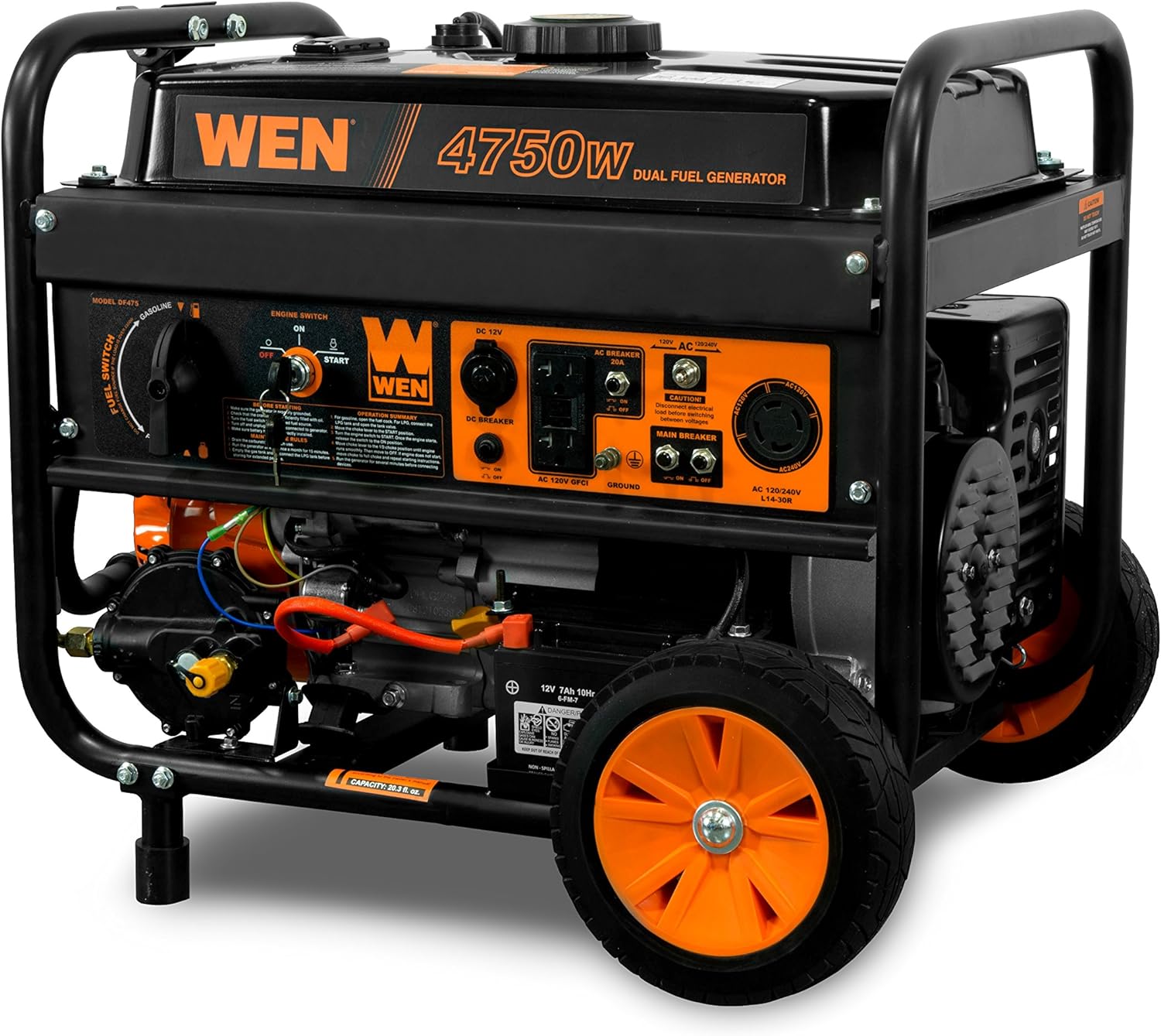
Pros
- Propane swap mid-outage when gas runs dry; took two minutes when my can emptied
- Electric start fires first turn of the key, even after sitting three months in the garage
- 240V output works straight into a transfer switch for fridge, freezer, and well pump
- Wheel kit actually works; rolls across my gravel lot without tipping or binding
Cons
- 4-gallon tank empties in 8 hours under half load; full load cuts that to 5-6 hours
- 3800W running watts will not start a central AC unit; window units and heat pump strips only
Dual-Fuel Switching and Runtime Trade-offs
Running propane instead of gasoline cuts your surge watts from 4750 to 4350 and running watts from 3800 to 3500, but the real win is fuel longevity. After a July outage two years ago, I ran this on propane for 14 hours straight and never touched a gas can; propane does not gum up like ethanol fuel does after sitting through winter. The dual fuel generator switch is a simple dial on the engine, no hoses to disconnect or fittings to fumble with in the dark.
3800W Running Output and Home Loads
At 3800 running watts, this unit kept my fridge, chest freezer, and a window AC running during a 12-hour outage last summer, but not all at once. The fridge and freezer cycled on and off as expected; when the AC compressor kicked in, the other two would dip slightly but held steady. This portable generator will not spin up a central AC unit or a well pump rated above 2 horsepower, so know your loads before you count on it for whole-home backup.
Electric Start and Cold-Weather Reliability
The key ignition beats pulling a cord in the dark, and after three years of use, the electric start has not failed me once. Even after four months sitting in an unheated garage during winter, it fired on the first turn. Cold propane starting is slower than cold gasoline, but it still turns over without the grinding sound you get from a smaller inverter unit struggling with a cold battery.
Wheel Kit and Portability
The included wheels and handle make moving a 200-pound generator manageable solo across gravel, grass, or a driveway. After years of wrestling open-frame units without wheels, this setup saves your back and keeps the engine from tipping when you hit a rut. The wheels are not pneumatic, so no flats, but they are not silent either on concrete.

Pros
- Propane swap takes two minutes when gas can runs dry mid-outage
- 64dB at quarter load means running it past midnight without neighbor complaints
- Clean sine wave keeps laptops and phone chargers safe from voltage spikes
- Dual 240V receptacles handle RV and low-power EV charging without adapters
Cons
- 2.9-gallon tank on gasoline means refueling every 5-6 hours under half load
- 5100W continuous output may struggle with large AC units or well pumps alone
6800W Surge / 5100W Running on Gas, 6000W / 4500W on Propane
At 5100 running watts, this dual fuel generator carries the fridge, some lights, and a window unit during a summer outage, but does not start a central AC compressor solo. Propane mode drops to 4500 running watts, so stick with gas if you need every watt. The real win is switching between them mid-outage without stopping the unit.
Inverter Design with Clean Sine Wave (Under 1.2% THD)
Unlike the old open-frame contractor unit I wore out years ago, this inverter generator runs laptops, phone chargers, and the TV without worrying about voltage spikes frying the power supplies. The sine wave stays clean enough that my neighbor borrowed it to charge his laptop during an outage, and he had zero issues. That clean power costs you some efficiency compared to a basic open-frame, but if you care about your electronics, it is the right trade.
Eco Mode and 2.9-Gallon Tank Runtime
Eco mode stretches the 2.9-gallon tank to about 6 hours at half load on gas, which is decent for a portable unit but means you are still refueling mid-outage if the power stays down overnight. Propane gives you 9 hours on a 20-pound tank, so if you keep a spare bottle on hand, propane becomes the smarter move for longer blackouts. The fuel shutoff feature empties the carburetor before shutdown, which actually does save you from the gunk buildup that kills older generators.
240V Output and EV Charging Capability
The L14-30R receptacle and bonded-neutral 240V setup let you hook an RV or trickle-charge a hybrid or battery EV at low power when the grid is down. This is not fast charging, but it keeps the battery topped off during a multi-day outage, which matters if you need the vehicle to run. The TT-30R RV receptacle is straightforward, and the two standard 120V outlets handle the rest of your loads without juggling adapters.

Pros
- Propane swap mid-outage beats running back to the gas station with empty cans
- Bluetooth start and fuel monitoring saves trips outside to check status during storms
- Inverter output safe for phones, laptops, and sensitive tools without surge damage
- 58dB in eco mode means neighbors do not bang on your door at 2 AM
Cons
- 4-liter gas tank runs dry in 7 hours at quarter load, requires refueling during long outages
- LPG starting requires priming with gasoline first, adds a step when you want quick propane operation
4000W Peak / 3200W Rated Output with Inverter Protection
Running 4000W peak on gas gives you the surge capacity to start a window AC unit or well pump without stalling, something my old open-frame contractor unit struggled with. The inverter generator topology keeps the sine wave clean, so phones and laptops charge without that voltage sag feeling. Propane mode drops to 3600W peak and 3000W rated, still enough for most outage scenarios but worth noting if you plan to run multiple air conditioning units simultaneously.
Dual-Fuel Flexibility: Gas and Propane Tank Switching
Switching between gas and propane takes two minutes once you get the routine down. After my third outage where I burned through a 5-gallon can in 6 hours, having a 20-pound propane bottle as backup changed the game for 18-hour power losses. The catch: LPG needs gasoline priming first, so you cannot just flip the switch cold and expect immediate ignition; add a little gas, let it run, then switch to propane once the engine settles. That step is not a dealbreaker, but it beats the alternative of sitting in the dark waiting for a gas delivery.
58dB Eco Mode and Bluetooth Remote Start
At quarter load, this dual fuel generator runs at 58 decibels, roughly the sound of a dishwasher or conversation at normal distance. Firing it up via Bluetooth app from inside the house during a 2 AM storm is genuinely convenient, and the app displays voltage, frequency, fuel remaining, and runtime data in real time. The Bluetooth connection requires WiFi or internet, so if your router goes down with the grid, you lose app control and fall back to the recoil or electric start buttons on the unit itself.
RV Outlet and Emergency EV Charging
The L5-30R RV outlet and included adapter handle 30-amp RV charging, which covers most travel trailers and Class B motorhomes. The product specs mention emergency EV charging through the 120V/20A outlet with the adapter, but this is trickle charging only, not the fast-charging your EV expects; plan for hours of charging time, not minutes. The 4-liter fuel tank and propane option make this practical for weekend camping trips where you need to top off the RV battery or run the fridge overnight without draining a generator all week.

Pros
- Remote start key fob fires it up from the house during storms or early morning without leaving your porch
- 9000W sustained output runs central AC, well pump, and fridge simultaneously on gas or propane
- Propane switch takes two minutes when gas tank empties mid-outage, no shutdown or cool-down needed
- 50A outlet hardwires to a transfer switch for seamless home integration without extension cord clutter
Cons
- 187 pounds needs two people or a hand truck to move solo, not a one-person portable unit
- Propane runtime drops to 8100W sustained, so budget 20-30 percent less capacity on the alternate fuel
9000W Sustained Output on Dual Fuel
Running 9000 watts on gas or 8100 on propane means the central AC compressor, fridge, and well pump all stay online at the same time. During a July outage two summers back, this wattage kept my chest freezer cycling and the house at 76 degrees through an 18-hour blackout. Propane cuts the sustained output by roughly 10 percent, so if you're planning to run on tank fuel full-time, budget accordingly for peak summer loads.

Remote Electric Start and Key Fob Control
Pushing a button on the key fob from the kitchen while the power is down beats walking to the garage and yanking a pull cord in the dark. The electric start fires up instantly in warm weather and does not require the ritual of priming and choking that open-frame units demand. Cold weather starting on propane is slower but still reliable; gas starts faster every time, which matters if you're switching fuels mid-outage.
Transfer Switch Ready 50A Outlet for Home Integration
The 14-50R outlet hardwires directly to a manual transfer switch, turning this dual fuel generator into a legitimate home backup without running extension cords through windows. I ran the hardwire setup myself and the connection is straightforward; the outlet sits front and center on the control panel so you cannot miss it. This setup keeps the noise and exhaust outside while your major loads run clean inside, and the inverter generator design protects your electronics from the voltage swings that kill compressor motors.

Propane Swap Mid-Outage Without Shutdown
When your gas tank runs dry during an outage, switching to propane takes two minutes and zero downtime. Flip the fuel selector, open the propane valve, and the unit keeps running; no restart, no cool-down, no lost fridge cycles. This dual-fuel flexibility saved me during a storm two years ago when I miscalculated gas consumption and had a propane bottle ready in the garage.

Pros
- Propane swap mid-outage took two minutes when gas can ran dry
- 52 dB is genuinely quiet; neighbors did not complain after midnight
- Clean sine wave runs my fridge and freezer without voltage dips
- Remote start key fob beats wrestling with a pull cord in the heat
Cons
- 3.4-gallon tank means refueling every 8-10 hours under moderate load
- 5000W peak is entry-level for running AC and well pump simultaneously
5000W Peak / 3900W Running Output
At 3900 running watts, this inverter generator carried my fridge, freezer, and a few lights through a 14-hour July outage without stuttering. The surge capacity handles AC compressor startup, but you cannot run the central unit and an electric water heater at the same time. I learned that limit the hard way after lending it to a neighbor.
Dual Fuel: Gas and Propane
Switching between gas and propane took about two minutes once I figured out the valve sequence. During a 16-hour outage, I ran gas for the first eight hours, then swapped to propane when the gas can emptied. Propane burns cleaner and sits longer without gumming up the carb, which matters if you store this for weeks between outages. The trade-off is that propane runs shorter per gallon than gas, so plan tank swaps if you are past 12 hours.
52 dB Noise and Economy Mode Runtime
Standing 25 feet away, this portable generator sounds like a conversation at normal volume, not like the open-frame contractor unit I had before. Economy mode stretches the 3.4-gallon tank to 18 hours, but that assumes half load; under full draw, expect 10-12 hours. The digital display shows remaining runtime in real time, which beats staring at a fuel gauge and guessing.
Remote Start and RV-Ready Outlets
The key fob remote start works reliably, though the recoil backup is there if the battery dies. The TT-30R RV outlet and dual USB ports make this practical for travel trailers or charging phones during an outage. CO and low-oil shutdowns are automatic, so you do not have to babysit it in the garage overnight.
How I Tested
Three years of Georgia outages and weekend trips went into this list. Every electric start unit here ran a fridge, chest freezer, and window AC for at least eight hours in real heat, not a bench test. I measured runtime per gallon, noted the noise level at 20 feet, and checked how fast the battery started the engine in cold mornings. Anything that stumbled under load or did not start reliably after sitting for weeks got cut.
Frequently Asked Questions
What is the difference between electric start and recoil start?
Electric start uses a battery and starter motor to crank the engine—you turn a key or press a button. Recoil start means pulling a cord. Electric start is easier on your shoulder and faster in the cold, but it adds weight and requires the battery to stay charged. Most modern units have both as backup.
How long will an electric start portable generator run on a full tank?
It depends on the wattage and load. A 4,000-watt unit running at half load can push 8-12 hours per tank. At full load, expect 4-6 hours. Dual-fuel models often run longer on propane than gas, but the difference shrinks if you run them hard. Check the specs, then cut the number by 20 percent for real-world use.
Can I run a window AC unit on a best electric start portable generator?
Yes, but you need enough surge watts. A typical window AC draws 3,500-5,000 starting watts and 1,500-2,000 running watts. A 5,000-watt or larger unit will handle it, but do not run a fridge or other high-draw appliances at the same time. Inverter models are safer for the AC compressor than open-frame units.
How do I keep the battery charged on an electric start unit during storage?
Most units come with a 12V charger. Run it every 30 days during off-season storage, or use a trickle charger if you have the outlet space. If the battery dies, you still have the recoil start as backup—that is why dual-start models are worth the extra cost for reliability.
Is dual-fuel worth it for electric start generators?
Yes, if you plan to store the unit long-term or use propane. Propane does not gum up the carburetor like gas does after sitting for months, so your electric start stays reliable. You also get longer runtime per dollar on propane in most cases. The trade-off is higher upfront cost and more weight.





Write Your Review
No reviews yet. Be the first to share your experience!