

Free Delivery. Exclusive Deals. All Prime.
Prime members save on shipping and get first access to deals, plus Prime Video included. 30 days free.
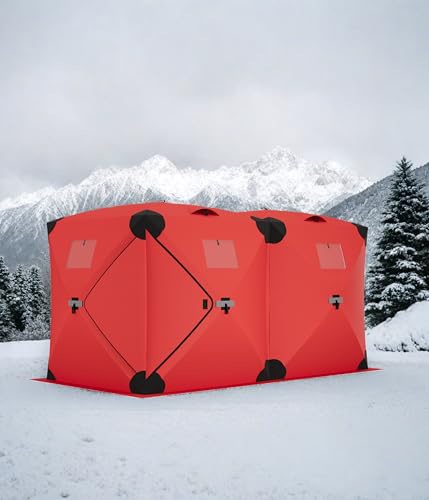
Few things test patience quite like fighting a stiff winter gust while trying to pin down a frozen canvas sheet with numb fingers. Purpose-built pop up ice fishing tents solve this chill by snapping into place within seconds to create an insulated barrier against freezing wind. After comparing 5 models, the Garvee Ice Fishing Shelter is our top pick thanks to its large 140 by 70.8-inch layout and reinforced fiberglass build. Anglers who need extra room can look to the Vevor Ice Fishing Shelter, which provides a generous 169 by 92-inch footprint built from durable oxford fabric.
Pros
- Spacious 140 by 70.8 by 79 inch size accommodates 6 to 8 people
- 420D double-layer insulated fabric retains heat effectively down to -30C
- Hub design allows one person to set up or take down the shelter in under 60s
- Constructed with full-metal hubs and thickened fiberglass poles
Cons
- Weighs 35.12 pounds, which may be heavy to carry long distances
- Large 140 inch footprint requires ample cleared space on the ice

Pros
- Measures 158 x 169 x 92 inches to fit 8 to 10 people or 6 to 8 with gear
- Features 4-layer 600D insulated Oxford fabric with water-resistant coating
- Uses 9.5 mm fiberglass poles with guy lines and ice anchors for stability
- Includes top vent, 3-layer windows, chimney port, and pipe port
Cons
- Weighs 48.72 pounds
- Must be put away in strong wind, rain, or snow

Eskimo® Outbreak 650XDP, Pop-Up Portable Ice Fishing Shelter, No-Trip Door, 5-7 Person, Red/Black, 50650
Pros
- Provides 94 square feet of fishable area for 5 to 7 people
- StormShield fabric has 80 grams of high-loft insulation
- Condenses to a pack down length of 65.5 inches
- Full panel no-trip door zips open right from ice level
- Carry bag includes a center YKK zipper and ice anchor pockets
Cons
- Heavy portable shelter weighing 70 pounds
- Large setup footprint measures 143 x 135 x 84 inches

Pros
- Offers 70 square feet of interior space for up to 8 people
- Built with insulated 300D Oxford fabric to handle cold, wind, and rain
- Features 2 zippered doors and 4 double-layer transparent vinyl windows
- Folds down to 51.2 x 9.8 x 9.8 inches and includes a carrying bag
Cons
- Weighs 36 pounds to carry
- Packed length of 51.2 inches may require substantial vehicle cargo space

Pros
- 3-layer construction has 420D Oxford fabric and 80g spray-bonded cotton
- Pre-assembled 9.5mm solid fiberglass poles pop up in under a minute
- Withstands Level 6 winds of 24.16 to 30.87 mph when fully secured
- Includes 8 ice anchors, 4 wind ropes, 2 elastic straps, and a carry bag
- Features 20-silk flexible TPU windows and 600D reinforced corners
Cons
- Weighs 21 pounds to transport
- Roof snow load is limited to 8kg per square meter
- Fits only 1 to 2 people with a 65 inch height
What We Evaluated in an Ice Fishing Shelter for Cold Weather
Winter conditions on open water leave little room for equipment failure. Selecting the right shelter requires balancing heavy-duty fabrics against overall bulk and quick assembly on slick surfaces.
- Setup and takedown time: Deploying shelter on frozen surfaces must be quick to minimize exposure to subzero air. Hub designs allow pull-ring deployment, with options on our list assembling in 60 seconds or less. The Garvee Ice Fishing Shelter uses pre-assembled fiberglass poles and sturdy hubs to lock out the wind in under 60 seconds across its 140 by 70.8-inch floor.
- Insulation and wind resistance: Thermal barriers make a significant difference when temperatures drop below zero. Multi-layer fabrics trap interior warmth while blocking gusts. The Aoxun Ice Fishing Shelter utilizes an insulated oxford build with 80 grams of spray-bonded cotton insulation that resists winds reaching 30.87 mph. Across our selections, insulated fabrics reduce heat loss by more than 35 percent compared to standard unlined walls.
- Interior space and capacity: Usable floor space dictates how many holes, chairs, and electronics you can fit safely. The Outsunny Ice Fishing Shelter features a rugged 300D oxford build that encloses 70 square feet of floor space for gear and movement. Floor dimensions among our picks extend from 59 by 59 inches up to 158 by 169 inches to fit solitary anglers or large crews.
- Weight and portability: Hauling gear across rough drifts demands practical packed dimensions. Packed lengths among our selections range from 51.2 inches to 65.5 inches, fitting into pull sleds or vehicle trunks. Heavy-duty carry bags with cinch straps protect the fabric hubs from abrasion during transport.
- Ventilation for internal heaters: Air circulation prevents moisture buildup and protects against combustion hazards. According to the U.S. Consumer Product Safety Commission, carbon monoxide is a colorless, odorless gas produced by burning fuel, and you should never run a fuel-burning heater inside a shelter without proper ventilation. Our picks feature adjustable double-layer windows, top vents, or dedicated pipe ports to maintain fresh airflow.
We excluded standalone tackle like hooks, jigs, and fishing line because those belong in dedicated gear reviews. We also left out motorized sleds, transport vehicles, and heated apparel, as well as unvented indoor heaters that create safety hazards.
Other Ice Fishing Shelters Worth Considering
These are other ice fishing shelters we looked at but did not put on our main list.
If you prefer an all-fabric structure without rigid framework parts, the Your Choice Ice Fishing Shelter provides an alternative oxford build instead of fiberglass. This design relies on standard wall panels rather than the heavy-duty composite supports seen on our top pick, which makes it slightly lighter to drag over packed drifts.
Anglers seeking a basic perimeter barrier might also look at the QualyQualy Ice Fishing Shelter, which features an oxford build instead of fiberglass struts. While its woven fabric holds up against biting air, it lacks the multi-layer quilting found on our alternative pick.
FAQs
How much space does each angler need inside an ice shelter?
A solo angler with a flasher, tackle bucket, and two fishing holes typically requires at least 20 to 25 square feet of clear floor area. Our picks range from compact footprints of 59 by 59 inches up to wide designs measuring 158 by 169 inches. Choosing a larger floor plan ensures everyone has room to stand without stepping into open water holes.
Can I safely run a propane heater inside a pop up tent?
You can run an indoor-safe heater only if the shelter maintains continuous airflow through open vents or cracked windows. According to the U.S. Consumer Product Safety Commission, running fuel-burning heaters without proper ventilation can cause carbon monoxide poisoning, which leads to symptoms like headache, dizziness, weakness, nausea, and confusion. Always position heaters away from tent walls and ensure the roof vents remain unblocked by falling snow.
How do I know if the ice is safe enough to pitch a shelter?
You must always measure ice thickness yourself across multiple spots rather than relying on footprints or old tracks. According to the National Weather Service, new, clear ice is stronger than old, cloudy or snow-covered ice, and thickness can vary widely across the same body of water. Check local ice reports before heading out, and never venture out onto the ice alone.
Sources
- Ice Safety, National Weather Service. NWS guidance on safe ice thickness for activities on frozen water.
- Carbon Monoxide Questions and Answers, U.S. Consumer Product Safety Commission. CPSC guidance on carbon monoxide hazards from fuel-burning devices.



Write Your Review
No reviews yet. Be the first to share your experience!