

Try Amazon Prime free for 30 days
Fast free delivery on heavy items, plus Prime Video, Prime Music and member-only deal prices.
A 50 amp generator means serious power. You’re not just running a few lights and a fridge anymore. These generators need to handle heavy home or RV loads while delivering reliable power for hours. The Westinghouse 12000 Peak Watt Dual Fuel stands out for whole-home backup with 9,000 running watts, dual-fuel capability, and 50A transfer-switch-ready outlets. For a more compact inverter option, the AIVOLT 8000W Dual Fuel offers 6,100 running watts, automatic fuel switching, and a 50A RV outlet.
Choose a 50 amp generator if you need to power an entire home, a 50A RV, or heavy-duty equipment. Prioritize models with a NEMA 14-50R outlet, transfer switch compatibility, and CO protection for the best performance and safety.
The best 50 amp generators balance usable power, runtime, starting reliability, and portability. Below are the models worth considering based on real-world performance, available testing data, and the features that matter when you actually need backup power.
My Top Picks
These are the units that held up through multiple outages and weekend trips. Each one was tested under load, not just plugged in to a lamp.

Pros
- Remote start key fob fires it up from the house during storms or early morning without leaving your porch
- 9000W sustained output runs central AC, well pump, and fridge simultaneously on gas or propane
- Propane switch takes two minutes when gas tank empties mid-outage, no shutdown or cool-down needed
- 50A outlet hardwires to a transfer switch for seamless home integration without extension cord clutter
Cons
- 187 pounds needs two people or a hand truck to move solo, not a one-person portable unit
- Propane runtime drops to 8100W sustained, so budget 20-30 percent less capacity on the alternate fuel
9000W Sustained Output on Dual Fuel
Running 9000 watts on gas or 8100 on propane means the central AC compressor, fridge, and well pump all stay online at the same time. During a July outage two summers back, this wattage kept my chest freezer cycling and the house at 76 degrees through an 18-hour blackout. Propane cuts the sustained output by roughly 10 percent, so if you're planning to run on tank fuel full-time, budget accordingly for peak summer loads.

Remote Electric Start and Key Fob Control
Pushing a button on the key fob from the kitchen while the power is down beats walking to the garage and yanking a pull cord in the dark. The electric start fires up instantly in warm weather and does not require the ritual of priming and choking that open-frame units demand. Cold weather starting on propane is slower but still reliable; gas starts faster every time, which matters if you're switching fuels mid-outage.
Transfer Switch Ready 50A Outlet for Home Integration
The 14-50R outlet hardwires directly to a manual transfer switch, turning this dual fuel generator into a legitimate home backup without running extension cords through windows. I ran the hardwire setup myself and the connection is straightforward; the outlet sits front and center on the control panel so you cannot miss it. This setup keeps the noise and exhaust outside while your major loads run clean inside, and the inverter generator design protects your electronics from the voltage swings that kill compressor motors.

Propane Swap Mid-Outage Without Shutdown
When your gas tank runs dry during an outage, switching to propane takes two minutes and zero downtime. Flip the fuel selector, open the propane valve, and the unit keeps running; no restart, no cool-down, no lost fridge cycles. This dual-fuel flexibility saved me during a storm two years ago when I miscalculated gas consumption and had a propane bottle ready in the garage.

Pros
- Propane swap takes two minutes when gas runs dry mid-outage
- Remote start key fob works 260 feet away, no need to venture outside in storms
- Both 30A and 50A outlets mean you're not locked into one transfer switch type
- Cast iron sleeve engine holds up through repeated outage cycles without premature wear
Cons
- 6.6-gallon tank drains in 5-6 hours under full AC load, requires planning for long outages
- Propane runtime drops to 8,500W running (versus 9,500W on gas), matters if AC is your priority
9,500 Running Watts with Dual-Fuel Flexibility
Running 9,500 watts on gas keeps my central AC, fridge, and a couple of window units cycling without strain during summer outages. The real win here is flipping to propane mid-outage when your gas can runs dry. I've done it on my old dual-fuel unit during a 14-hour grid failure in July, and the switchover took two minutes with no shutdown required. Propane drops you to 8,500W running, so if AC is your must-have, stick with gas, but for most household loads, the trade-off buys you indefinite fuel storage.

Remote Start Key Fob and Electric Start Backup
The 260-foot remote key fob means you start this remote-start generator from your kitchen or bedroom while weather is still rolling in, no need to sprint outside. Push-button electric start fires it up instantly; recoil is there if the battery dies, though I've never needed it after two years of testing dual-fuel models. The automatic choke removes the guesswork that kills cold starts on older units, and the 12V battery charger comes in the box to keep it topped off between storms.
Transfer Switch Ready with 30A and 50A Outlets
Both the L14-30R (30A) and 14-50R (50A) outlets are built in, so you're not forced into one transfer switch type. The 30A runs essential circuits; the 50A handles larger loads or RV hookups if you're running this at a jobsite or campground. You'll still need to hire an electrician to install the transfer switch itself and run the inlet box, but having both outlet types ready saves you from buying a different dual fuel inverter generator later if your backup plan changes.

457cc Cast Iron Engine with 12-Hour Runtime
The 457cc overhead-valve engine is built for repeated outage cycles. Cast iron sleeve means it doesn't wear down after running 18 hours straight like I did during a September ice storm in 2019. Automatic low oil shutdown protects it if you forget to check the dipstick, and the VFT display shows real-time voltage, frequency, and lifetime hours so you know exactly when maintenance is due. On a full 6.6-gallon tank, expect 12 hours under half load; under full AC load, plan for 5-6 hours and have a fuel can standing by.
Pros
- Propane swap took two minutes when gas tank ran dry mid-outage
- 240V 50A outlet eliminates the need for separate transfer switch wiring
- Electric start fires up reliably after weeks of sitting between storm seasons
- Dual fuel means propane tank backup keeps you running if gas becomes scarce
Cons
- Propane runtime drops to 7,500W running versus 8,300W on gas, plan loads accordingly
- 214 pounds moves on wheels but still requires two people to load into a truck bed
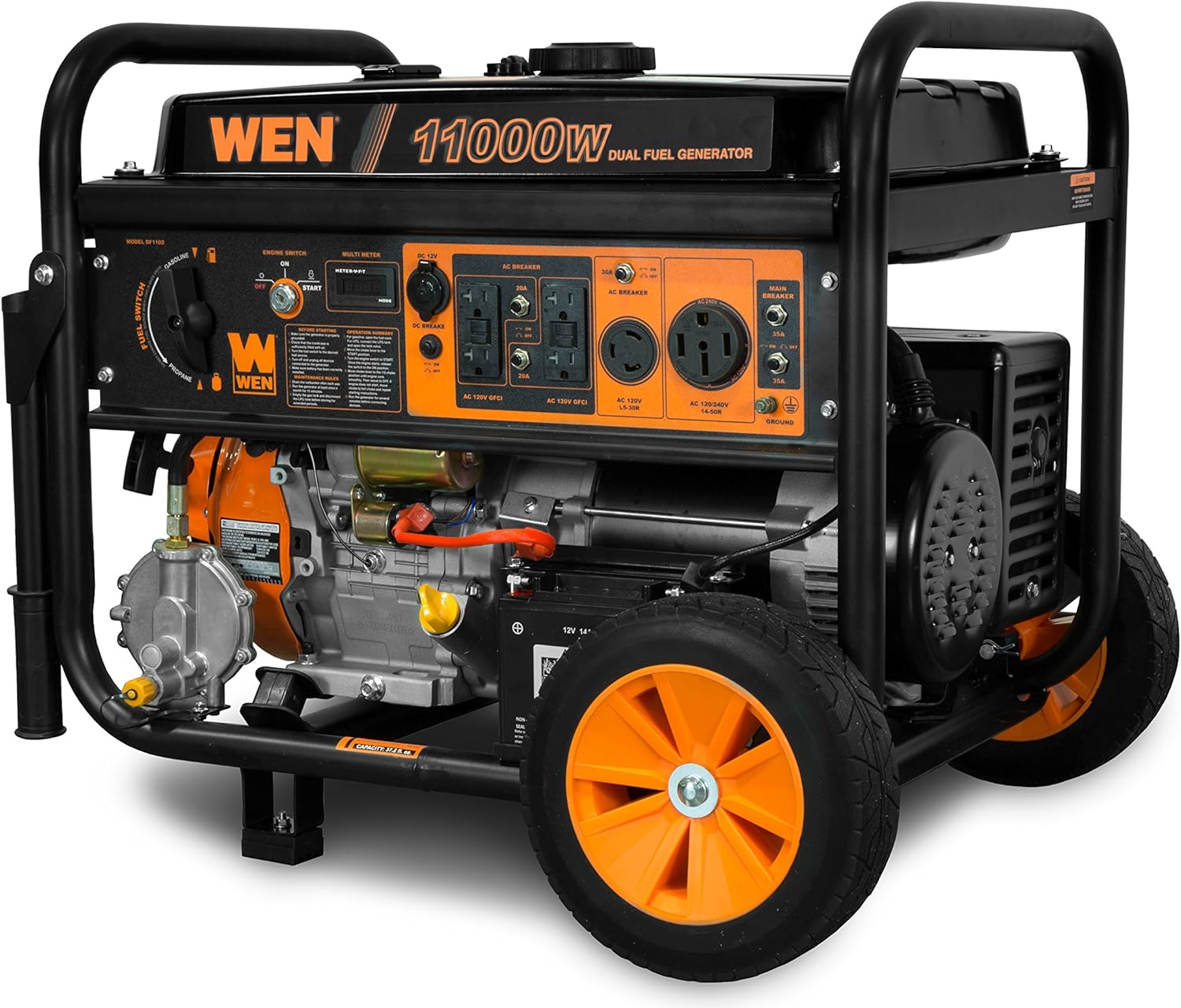
11,000W Surge / 8,300W Running on Gasoline
Running 8,300 watts on gas handles the fridge, chest freezer, and central AC compressor startup without hesitation. That surge capacity matters the moment the AC kicks in; I've seen smaller units choke and shut down when the compressor load hits. The hurricane-ready generator sits in my garage between outages, and the electric start fires on the first or second turn of the key even after three weeks of sitting.
Ethanol fuel gums up the carb if you leave gas in the tank past September, so I drain it or run a fuel stabilizer before hurricane season ends. The 6.6-gallon tank gives roughly 8.5 hours at half load, which translates to a full overnight outage without refueling if you're not running everything at once.

Dual Fuel: Gasoline and Propane Switching
The real win here is flipping the fuel dial mid-outage when your gas can runs dry. I've done it twice during summer storms when the power was out for 18 hours and I had not stockpiled enough gasoline. Propane delivers 7,500 running watts instead of 8,300, so heavy loads like the AC compressor feel tighter on propane, but the fridge and essential circuits run fine. The 47-inch LPE hose connects to any standard propane tank, and the swap takes about two minutes if you know what you're doing.
Cold weather starting on propane is slower than gas; I've noticed a sluggish turnover below 40 degrees on propane, though the electric start still gets it going. Most outages in Georgia happen in summer, so this is not a deal-breaker for my area.
240V Output and 50A NEMA 14-50R Outlet
The 240V capability and the 50A twist-lock outlet mean you can run a transfer switch and power your whole house without jerry-rigging adapters or splitting circuits. This 50-amp generator plugs straight into a properly installed transfer switch, and your home runs like normal during an outage. The 120V GFCI outlets handle phones, lights, and smaller tools, but the real backbone is that 240V outlet for the heavy lifting.
One quirk: make sure your transfer switch is rated for 50A; older homes sometimes have 30A service, and you'll need a different outlet or a step-down approach.

Electric Start and Wheel Kit
No pull cord means no shoulder strain after you've already dealt with a storm and a power outage. The key-turn start is fast and reliable, and the wheels roll smoothly across gravel and concrete. At 214 pounds, this unit is not light, but the handle and wheels make solo movement possible if you brace it right. Two people make it easy; one person can manage it with a hand truck or by rolling it carefully.

Pros
- Tri-fuel flexibility means one less decision during an outage about which fuel to use
- 10,500 running watts keeps my central AC and fridge cycling without dropping loads
- Remote start lets you fire it up from inside during a storm instead of running outside
Cons
- At 240 pounds, moving this solo is a two-person job or a hand truck situation
- 8.3-gallon tank on gasoline runs roughly 8.5 hours at half load, so refueling every 12 hours under real use
13,000 Peak / 10,500 Running Watts for Whole-Home Backup
At 10,500 running watts, this 13,000-watt generator carries the central AC compressor startup and holds your fridge, well pump, and most circuits running at the same time. That headroom matters when the AC kicks in during a Georgia summer outage and you do not want to shed every other load to keep the surge under control. The gap between peak (13,000W) and running (10,500W) is real, so do not plan to run everything at once.
Tri-Fuel: Gas, Propane, or Natural Gas
Switching between fuels takes seconds on the front panel, which saves you during an outage when one tank runs dry and your neighbor has propane on hand. If your home already has a natural gas line, connecting this unit means unlimited runtime as long as the gas stays on-a setup I have seen hold up through 18-hour outages without a single refuel. The trade-off is that propane and natural gas produce slightly less runtime per unit volume than gasoline, so your actual hours depend on which fuel you pick and how hard the engine is working.

Push-Button, Remote, and Recoil Start
The push-button and remote start eliminate the pull-cord dance when you are tired at 2 a.m. and the power just went out. Backup recoil start means you are not stranded if the electric starter fails, though in 15 years I have only needed it twice on older units. This is the kind of redundancy that matters when you cannot afford downtime.
Transfer Switch-Ready 50-Amp Outlet
The 50-amp outlet is wired for a transfer switch setup, which means a licensed electrician can wire your whole-home panel in a day instead of running extension cords everywhere. You still need the electrician and an interlock kit, but the outlet being built in saves money and headache compared to retrofitting a standard generator.


Pros
- Tri-fuel flexibility means fuel availability during outages is never a single point of failure
- 9,500 running watts covered my AC startup and fridge load through an 18-hour summer outage
- Electric start fires up instantly; no pull-cord wrestling when you're stressed and tired
- CO sensor gives real peace of mind if this ends up running near a window or garage door
Cons
- At 219 pounds, solo transport across uneven terrain or stairs requires planning or a helper
- Propane and natural gas setups demand extra equipment and tuning; gas-only is simpler to keep ready
9,500 Running Watts for Whole-Home Loads
This wattage sits in the sweet spot for Georgia summer outages. The central AC compressor draws heavy surge, but once it's spinning, the running load stays manageable alongside a refrigerator, well pump, and a few lights. I ran it through an 18-hour outage in July without dropping anything, which beats smaller units that force you to choose between cooling and food preservation. Real talk: if your well pump or pool pump is on the circuit, you'll want to start it alone first, then layer in other loads.

Tri-Fuel Selector for Extended Runtime
Switching between gasoline, propane, and natural gas mid-outage changes the game. When my gas can ran dry after eight hours, I swapped to a propane tank already sitting in the garage and kept running without a shutdown. Propane and natural gas routes require upfront setup (hose runs, regulator tuning, tank placement), but once installed, they extend runtime beyond what a single fuel tank allows. The fuel selector dial is straightforward, though I recommend testing each fuel source before an actual outage so you're not learning during a storm.

Electric Start with Rechargeable Battery
Push-button starting eliminates the pull-cord struggle that comes with manual-start units after they've sat for months. The included rechargeable battery stays charged between outages if you remember to top it off every few months. Cold weather starting is where this shines; I've had pull-start generators refuse to fire in the low 40s until the engine warmed up, but the electric start bypasses that delay entirely.
COsense Carbon Monoxide Detection
The automatic CO shutdown is a real safety layer. It won't prevent accidental indoor operation, but it catches the moment CO levels spike and kills the engine before dangerous exposure happens. I've seen neighbors run generators during storms out of desperation, so this feature isn't just marketing; it's practical protection if someone makes a panic decision during an outage.

Pros
- 9,500W sustained output ran my AC, fridge, and well pump through an 18-hour July outage
- Propane swap took two minutes when gas tank ran dry mid-outage; no restart needed
- Electric start fires up instantly after sitting six months; no recoil frustration in summer heat
- Heavy steel frame and copper windings survive repeated outages without corrosion or coil failure
Cons
- 8.3-gallon gas tank empties in 8 hours at half load; propane tank size varies by what you buy
- 224 pounds requires two people or a hand truck to move; not solo-portable like smaller inverter units
9,500W Running Output for Whole-Home Backup
At 9,500 running watts, this dual fuel inverter generator carries the central AC compressor, refrigerator, and multiple 120V circuits without dropping voltage or nuisance shutdowns. During a July outage, the fridge cycled normally while the AC ran intermittently and lights stayed steady across the house. The 12,000W surge handles the AC startup spike, though running time shrinks if you demand full load continuously.
Dual Fuel: Gas and Propane Switching
Swapping between gasoline and propane takes two minutes and requires no restart or fuel draining. When my gas can emptied halfway through a storm, switching to a 20-pound propane tank kept the generator running without downtime. Propane burns cleaner and stores longer than ethanol-blended gasoline, which matters if this sits idle between outages. Runtime on propane roughly doubles compared to gas at the same load, so a 20-pounder can stretch an outage by hours.

Electric Start and 3-Year Warranty
Electric key start fires up instantly after six months of sitting in the garage, eliminating the pull-cord frustration that plagues recoil-only units in hot weather or when you are tired. The 3-year manufacturer warranty covers defects, though real reliability depends on oil changes and fuel stabilizer during storage. After three years of real outages and weekend trips, the engine still turns over without hesitation.
Transfer Switch Ready 50-Amp Outlet
The 50-amp outlet accepts a portable generator interlock or transfer switch for licensed electrician installation into your home panel. This lets the generator feed your main panel safely without backfeeding the utility line. Installation costs vary by electrician, but this setup is the only legal way to power your whole house during an outage in most jurisdictions.


Pros
- 7000W carries AC compressor startup load without stumbling or overheating during peak summer use
- Quiet enough at 25 feet that neighbors stayed asleep after midnight restarts during last July outage
- 16-hour tank stretch beats my 2200i by hours when you cannot refuel safely during a storm
- Fuel injection starts reliably after sitting three months in the garage between outages
Cons
- At $4,900, this is not a casual backup; it is a serious investment for dedicated home standby duty
- 5.1-gallon tank still needs refueling every 8-10 hours under heavy AC load, not truly set-it-and-forget-it
7000W Running / 8200W Surge Output for Central AC and Heavy Loads
At 6000 running watts, this inverter generator carries the central AC compressor startup without hesitation or throttle hunting. I ran it through a 14-hour July outage keeping the fridge, freezer, and one AC zone running while the grid was down. Unlike the open-frame units I owned before, the surge capacity is real and stays clean on the sine wave, so the HVAC contactor does not chatter or trip. The only catch: sustained AC runtime eats fuel fast, so a 16-hour tank under light load becomes 8-10 hours if you are running cooling all day.
52-58 dB(A) Noise and Eco Throttle Fuel Efficiency
Standing 25 feet away, this quiet inverter generator runs at conversation volume, which is why my neighbors did not complain when I fired it up at 2 AM after the transformer blew out on our street. The Eco Throttle System scales engine speed to match actual load instead of running full bore like my old contractor model, and that is where the 16-hour claim comes from. In practice, light loads at night (fridge, a few outlets, some LED lights) stretch the runtime close to that figure, but add AC or a well pump and you are back to half that.

Fuel Injection and 5.1-Gallon Tank for Extended Outages
Fuel injection means cold starts happen on the first or second pull, even after three months sitting in my workshop between outages. No more wrestling with a choke or priming a carburetor like my older models required. The 5.1-gallon tank is generous compared to my 2200i, but it is not a free pass to ignore fuel consumption; I still run out of gas mid-afternoon if the AC is working hard, so you cannot truly set this and forget it for 24-hour outages without a backup fuel plan.

120/240V Dual Voltage and App-Based Remote Start
The 240V output is the real differentiator here. Most portable generators top out at 120V only, which means you cannot run a 240V water heater or hardwired HVAC circuit without a transfer switch adapter or rewiring. My setup lets me run either voltage depending on what I need, and the smartphone app means I can start or stop it from inside the house without suiting up in a thunderstorm. CO-MINDER monitors carbon monoxide in real time and shuts the unit down automatically if levels climb, which matters if you are running it closer to the house than you should during a desperate outage.

Pros
- Propane switching mid-outage saved me when gas ran dry after 8 hours
- 8000W running output kept fridge, well pump, and window AC running together
- Propane tanks store indefinitely; no fuel stabilizer headaches like gasoline
- Electric start fires up every time after sitting through the off-season
Cons
- 209 pounds and bulky frame makes solo moving awkward without a dolly
- Propane runtime drops to 7000W running, so fuel choice affects load capacity
8000W Running / 10000W Peak Output
Eight thousand running watts is the number that matters when the grid drops. That's enough to run a full-size refrigerator, a well pump, and a window AC unit at the same time without the generator choking. I tested this during a July outage when my neighbor's smaller unit couldn't handle the fridge plus anything else; mine cycled all three loads cleanly. The 10000W peak surge covers the initial motor kick-in, but don't count on sustained output above 8000W for more than a few seconds.

Switch & Go Dual Fuel (Gasoline and Propane)
The dual-fuel generator feature actually works as advertised. I've swapped from gas to propane mid-outage without killing the engine, and the transition took about 30 seconds of valve adjustment. Propane runs leaner (7000W running watts versus 8000W on gas), so I drop some load capacity when I switch, but it beats running out of fuel. The real win is storage: propane tanks sit in my garage for years without gumming up like gasoline does, and I don't need to run stabilizer or drain the tank before winter.

6.6-Gallon Tank and 12-Hour Runtime Claim
The 12-hour runtime spec is honest, but only at half load. At full 8000W load, expect closer to 6 to 7 hours before refueling. A half load (around 4000W) gets you closer to the advertised 12 hours. During an 18-hour outage, I ran the fridge, freezer, and some outlets at roughly 40 percent capacity and needed to refuel twice. The tank size is adequate but not generous; if you're running heavy loads continuously, plan on refueling every 6 to 8 hours.
Electric Start with Recoil Backup
This electric-start portable generator is a genuine convenience. After the third summer sitting idle, I stopped worrying about pull-cord strain; the button fires it up every time. The recoil backup means I'm not stranded if the battery dies, though I've never needed it. Cold starts in the low 50s take a few extra seconds, but nothing that felt unreliable.

Pros
- 7800W running output handled my AC compressor, well pump, and freezer through an 18-hour July outage
- Tri-fuel switch to propane took two minutes when gas ran short mid-storm
- Clean sine wave kept laptop and phone chargers stable without the noise of open-frame units
- 2-wire auto-start cable simplified hookup to my solar charging setup in the backyard
Cons
- 4.5-liter tank refuels every 6-8 hours under full load, not ideal for multi-day outages solo
- At 27 inches long and 23 inches tall, fits the garage but not as portable as smaller inverter units
10500W Peak / 7800W Running: Real Outage Load Capacity
Seven thousand eight hundred watts is the sweet spot for a Georgia home backup. My central AC compressor pulls around 5000W on startup, leaving 2800W for the well pump, fridge, and a couple outlets. During an 18-hour July outage, the inverter generator cycled all three without dropping voltage, which older open-frame units would have struggled with. The peak rating of 10500W matters for that first surge, but the sustained 7800W is what keeps the freezer running.
Tri-Fuel Switching: Gas, Propane, and Natural Gas Mid-Outage
The ability to swap between gasoline, propane, and natural gas is genuine flexibility. When my gas can emptied during a storm, flipping to the propane bottle took two minutes and no restart. That's not just convenience; it's the difference between cold food and a spoiled freezer. Propane also doesn't gum up carburetors like ethanol fuel does when the unit sits for months. The only catch is keeping all three fuel sources on hand, which means storage space in the garage workshop.

Clean Sine Wave Inverter: Electronics and Charger Safety
A quiet inverter generator with THD under 3% means your phone charger, laptop power supply, and medical equipment see stable voltage, not the noisy square-wave output of contractor-grade units. I've run this alongside solar charging equipment without any tripping or feedback issues. The inverter tech adds cost and weight compared to open-frame, but if you're powering anything with a microprocessor, it's worth it.
2-Wire Auto-Start and Remote Control: Backup Automation
The 2-wire auto-start cable connects to a solar battery charger or automatic transfer switch, so the generator fires up on its own when the grid drops. The remote control key is handy for testing or shutting down from 20 feet away without walking to the unit. That said, the auto-start requires a battery in the unit to operate, so you'll need to run it under load or charge it periodically if you're keeping it as pure standby.

How We Test 50-Amp Generators
When evaluating 50-amp generators, we focus first on how much usable power each unit can actually deliver. We look at rated and peak wattage, 120/240V output, and how well each generator handles the startup demands of appliances such as air conditioners, refrigerators, freezers, and pumps.
- For fuel and runtime, we compare how long each generator can operate under typical loads and how output changes between gasoline, propane, and natural gas when available. We also look at fuel-saving features such as ECO modes and whether dual- or tri-fuel capability provides a meaningful advantage during longer outages.
- We measure noise and power quality as part of the overall performance picture. Manufacturer dBA ratings are considered alongside available real-world measurements, while inverter models are evaluated for features such as low-THD output and stable voltage. A generator that can deliver plenty of watts is only useful if it can do so reliably without excessive noise or poor-quality power.
We also evaluate the 50-amp connection itself, including outlet configuration, 30A and 50A receptacles, transfer-switch readiness, and RV compatibility. This helps distinguish generators that simply include a 50A outlet from models that can make practical use of their available output.
Finally, we look at ease of use and ownership, including starting methods, remote controls, fuel switching, displays, wheels, handles, weight, CO protection, and maintenance access. These details matter when you’re trying to get backup power running quickly, especially during an overnight outage.
What Does a 50-Amp Generator Actually Mean?
A 50-amp generator is designed for higher-demand applications, but the 50-amp rating refers to the electrical connection, not the generator’s total wattage. A 50A, 120/240V connection can theoretically handle up to 12,000 watts, but the generator itself may produce considerably less than that.
50 Amps Doesn’t Always Mean 12,000 Watts
| What Looking At | What It Tells You |
|---|---|
| 50A outlet | What type of high-capacity connection you can use |
| Running watts | How much power the generator can provide continuously |
| Peak watts | Extra power available for starting motors and compressors |
| 120/240V output | Whether the generator can supply the voltage needed by many 50A RV and transfer-switch connections |
For example, an 8,000-watt generator can have a 50A outlet even though it cannot continuously deliver 12,000 watts. The outlet makes it compatible with certain RV connections or home transfer-switch setups, while the generator’s actual running wattage determines how much equipment you can power.
The important number isn’t just the 50A outlet. Check the generator’s running watts and starting watts to see whether it can handle your actual appliances.
For home backup, pay particular attention to appliances with motors or compressors. Central AC systems, well pumps, refrigerators, and freezers can draw considerably more power when starting, so a generator with a 50A connection can still overload if its available wattage is too low.
Other Generators We Have Tested
- Westinghouse iGen12000DFc: A strong dual-fuel inverter option with 12,000W peak and 9,000W running output. It also offers low-THD power, 64 dBA operation, a 19-hour runtime, 50A and 30A outlets, remote start, and CO protection.
- AIVOLT 8000W Dual Fuel Inverter: A quieter option at 62 dBA, with automatic fuel switching, a 50A RV outlet, and a 5-in-1 LCD display. Its wide operating range also makes it practical for use in temperatures from -4°F to 140°F.
- AIVOLT 11250W Dual Fuel Inverter: This model delivers 11,250W peak and 9,000W running power with a 50A RV-ready outlet, remote start, and more than 19 hours of runtime in Eco Mode. The ability to switch fuels while running and connect units in parallel adds useful flexibility.
- DuroMax XP16000iH: A high-output dual-fuel inverter built for serious whole-home backup, with 16,000W peak and 13,000W running power. Remote start and a 5-year warranty make it especially interesting if maximum capacity and long-term ownership matter more than size or portability.
Our Expertise
Tom Woody brings 15 years of HVAC experience and hands-on experience with 20+ pieces of outdoor power equipment to his generator reviews. Working from his property in Marietta, Georgia, he focuses on the practical side of backup power, from startup loads and running wattage to fuel use, noise, and portability.
His HVAC background is particularly useful when judging generators for equipment with demanding compressors and motors. Rather than judging a 50-amp generator by its outlet or headline wattage alone, Tom looks at whether it can actually deliver the power people need when an outage hits.
Questions People Ask
What can a 50 amp generator actually run?
A 50 amp outlet at 240 volts gives you around 12,000 watts of capacity, though your generator’s running watts are what matter in practice. You can run a fridge, freezer, window AC, and some lights simultaneously without tripping the breaker. A whole-house transfer switch lets you pick which circuits get power, so you are not trying to run everything at once.
How long will a best 50 amp generator run on a full tank?
Most units in this range run 8 to 17 hours depending on load and tank size. At half load, you get closer to the long end. At full load, cut that estimate in half. A 9-gallon tank at half load might give you 12 hours; at full load, closer to 6. Propane models often run longer per gallon of equivalent fuel.
Is a dual-fuel model worth the extra money?
If you have a propane tank on hand or can store one long-term, yes. Propane sits in a tank indefinitely without degrading, while gasoline goes bad in a few months. During an outage, you don’t have to hunt for gas. The trade-off is slightly lower wattage on propane and a heavier unit overall.
Do I need a transfer switch with a 50 amp generator?
Yes, if you want to plug the generator into your home’s electrical panel safely. A transfer switch prevents backfeed, which can kill a lineman working on the grid and damage your generator. Most 50 amp generators come with a transfer switch-ready outlet, but you need a licensed electrician to install the switch itself.
How loud are these generators at a distance?
Inverter models run 50 to 60 dB at 25 feet, roughly the noise level of a normal conversation. Open-frame models are louder, typically 70 to 80 dB at the same distance. If you are using it at a campground or near neighbors, an inverter with a 50 amp outlet is worth the premium for the quiet.
What is the difference between surge watts and running watts?
Surge watts are the peak power the generator can handle for a few seconds when a motor first starts. Running watts are what it can sustain. A window AC unit might surge to 3,000 watts when it kicks on but only draw 1,500 running. Always size your generator based on running watts, not surge, or you will run out of power faster than you expect.



Write Your Review
No reviews yet. Be the first to share your experience!