

Free Delivery. Exclusive Deals. All Prime.
Prime members save on shipping and get first access to deals, plus Prime Video included. 30 days free.
The campsite coffee is still hot, the dash says a tire is low, and the nearest air hose is behind a gas station snowbank. Portable air compressors for RV tires solve that by bringing inflation power to the rig. After comparing 2 models, the Viair Portable Air Compressor is our top pick for its 12V setup, 150 PSI ceiling and 100% duty cycle at 100 PSI. The All-Top Portable Air Compressor is our alternative pick because it is a 12V unit with an aluminum build.

Pros
- Up to 150 PSI for RVs, trucks, SUVs, Jeeps and trailers
- 100% duty cycle at 100 PSI for extended inflation tasks
- 1.80 CFM free-flow rate for large vehicle tire inflation
- Automatic pressure cut-off helps when moving tire to tire
- Includes deluxe carry bag for storage and transport
Cons
- Requires direct connection to a 12V vehicle battery
- Engine must be running during compressor operation
- 13.05 lb weight may be bulky for some storage spaces

Pros
- 150 PSI max pressure rating
- 12.35 ft³/min air flow
- Dual aluminum cylinders for heat dissipation
- Includes 26 ft rubber air hose with gauge
- Auto thermal cut off and over current protection
Cons
- 24 lb weight may be bulky to carry
- Requires over pressure protection with own inflator gauge
- Designed for 12V use only
What Matters in Portable Air Compressors for Cold-Weather RV Tires
Cold weather can turn a routine pressure check into a longer stop, especially when an RV tire needs more air than a small car tire. For this job, the compressor needs enough 12V capability, enough hose reach, and controls that make pressure checks less awkward around a large vehicle.
- Power source and inflation speed: A direct 12V connection is the practical baseline for RV travel because it uses the vehicle battery rather than a wall outlet. The Viair Portable Air Compressor is rated to 150 PSI and lists a 1.80 CFM free-flow rate, which makes it better aligned with large RV and truck tires than a small emergency inflator. It also has a 100% duty cycle at 100 PSI, a useful number when cold weather means checking more than one tire.
- Gauge accuracy and automatic operation: Among our picks, both compressors list a maximum pressure of 150 PSI, so the control side matters as much as the pressure ceiling. Our top pick includes an automatic pressure cut-off sensor that cycles the compressor while the inflation gun is engaged. Our alternative pick includes a pressure gauge on its 26-foot rubber air hose, which keeps pressure checks at the tire instead of back at the compressor.
- Hose length and attachments: Hose reach decides whether you can work around a motorhome without constantly repositioning the compressor. Among our picks, hose length is listed at 26 feet for the alternative pick, while the top pick includes a close-ended gas station-style inflation gun for controlled airflow. The alternative pick also includes 3 nozzle adapters, which broadens its use beyond RV tires to smaller inflatables and recreational gear.
- Portability and storage: RV storage space is limited, so a compressor has to pack away cleanly after the pressure check is done. Among our picks, one unit lists a 24-pound weight and includes a nylon tool bag, while the other includes a deluxe carry bag for compartment or cargo-area storage. The lighter detail is not available for both picks, so the safer comparison is that both include dedicated storage bags rather than loose hoses and fittings.
We excluded jump starters and battery chargers because they are a different emergency tool, even when some include inflation features. We also left out shop-grade workshop compressors for tools because a garage compressor has a different job than roadside or campsite tire inflation.
The Competition
These are other portable air compressors we looked at but did not put on our main list.
If a built-in battery matters more than direct RV-battery operation, Etenwolf Portable Tire Inflator has a 19,200 mAh battery. That can be convenient for smaller pressure checks, but it does not match the RV-specific need as closely as our main list, where 12V vehicle power and large-tire pressure support are central.
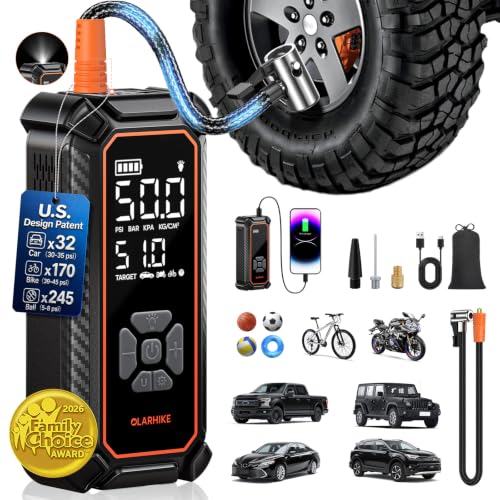
For shoppers who want both battery backup and a vehicle connection, OlarHike Portable Tire Inflator lists 12V power and a 12,000 mAh battery. That mix is useful on paper, but the main picks are more clearly framed around RV and truck tire maintenance rather than general portable inflation.
Prefer a familiar tool brand for occasional tire work? Dewalt Portable Tire Inflator lists 12V power, thermostat control, rubber build and a 3-year warranty. Those are helpful numbers and materials for durability, but it is still less closely focused on RV tire inflation than our top pick, which lists a 150 PSI ceiling and a 100% duty cycle at 100 PSI.
And if simple 12V operation is the whole reason you are shopping, UUP Portable Tire Inflator belongs on the comparison list. The issue is that 12V alone does not tell you enough about extended RV-tire work, so our main list gives more useful numbers for pressure capacity, hose setup and storage.
FAQs
Why does 12V power matter for RV tire inflation in cold weather?
A 12V compressor can run from the vehicle battery, which is useful when a campsite or roadside stop has no accessible AC outlet. Cold-weather pressure checks often happen before departure, so a vehicle-powered setup keeps the compressor tied to the rig instead of to a building.
How much pressure capacity should I look for?
Our picks both list a 150 PSI maximum, which gives headroom for many RV and truck tire maintenance tasks. The pressure ceiling is not the only number to watch, because duty cycle and airflow also affect how practical the compressor is when more than 1 tire needs attention.
Is a longer hose important for an RV?
Yes, because an RV is harder to work around than a small car. Among our picks, the listed hose length reaches 26 feet on one model, which can reduce how often you have to move the compressor while checking multiple tires.
What winter safety step should I remember before inflating tires?
According to the Centers for Disease Control and Prevention, snow blocking a vehicle tailpipe can cause carbon monoxide to build up quickly inside the vehicle. Before driving or running the engine for a 12V compressor, check that the tailpipe is clear of snow.
Sources
- Clear Snow from Tailpipes, Centers for Disease Control and Prevention. CDC warning about snow-blocked vehicle tailpipes.
- Safety Guidelines: During & After a Winter Storm, Centers for Disease Control and Prevention. Winter heating safety for space heaters, kerosene heaters and carbon monoxide.





Write Your Review
No reviews yet. Be the first to share your experience!