

Free Delivery. Exclusive Deals. All Prime.
Prime members save on shipping and get first access to deals, plus Prime Video included. 30 days free.
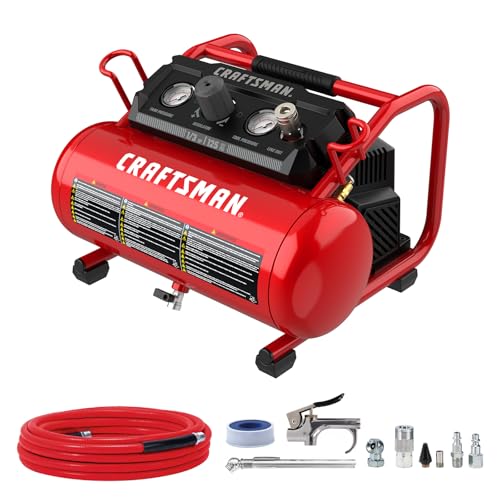
The low-tire light has a talent for appearing when your coffee is still too hot and the driveway is too cold. Small portable air compressors solve that by letting drivers add air close to the car instead of hunting for a working gas-station pump. After comparing 2 models, the Craftsman Portable Air Compressor is our top pick for its 2-gallon tank, 1/3 HP motor and 19-pound weight. The Ironton Portable Air Compressor is our alternative pick because its 3-gallon tank reaches 110 PSI.
Pros
- Lightweight at 19 lbs with handle for easy portability and storage
- 2 gallon tank with 125 PSI maximum pressure for tire inflation
- Includes 10 accessories: hose, gauges, couplings, blow gun, and adapters
- Oil-free pump requires no maintenance and reduces durability concerns
- 1/3 HP motor with overload protection and heat dissipation system
Cons
- Heavier overall weight of 24.5 lbs when fully assembled with tank
- 2 gallon tank capacity is smaller than many workshop air compressors
- Requires electrical power outlet; not cordless or battery-powered

Pros
- Oil-free pump needs no oil checks or changes
- 3-gallon pancake tank with 110 PSI max
- Auto on at 85 PSI and auto off at 110 PSI
- Wide pancake base for stable placement
- Fold-down handle and cord wrap aid storage
Cons
- Air delivery rate is not listed
- Noise level is not listed
- No included accessory list provided
How We Chose Small Portable Air Compressors for Cold Weather Tire Care
Cold weather makes tire-pressure maintenance more of a routine chore than a once-in-a-while task. For that use, the most useful portable air compressor is not simply the biggest one, it is the one with the right power setup, clear pressure control and enough portability to keep near the vehicle.
- Power source and inflation speed: We looked first at how each compressor is powered and what its motor and tank numbers suggest about steady air delivery. The Craftsman Portable Air Compressor uses an AC-style compressor format with a 1/3 HP motor and a 2-gallon tank, which suits garage and driveway tire top-offs better than a tiny emergency-only inflator. Its maximum pressure is 125 PSI, giving it enough headroom for common passenger-vehicle tire pressures.
- Gauge accuracy and auto shut-off: For tires, pressure control matters because a few PSI can change how a car feels in cold weather. Among our picks, maximum pressure ranges from 110 PSI to 125 PSI, and both use pressure cycling or regulation rather than a simple on-off pump alone. One pick has an auto-on point at 85 PSI and an auto-off point at 110 PSI, which helps the tank maintain a working pressure band.
- Hose length and attachments: Attachments decide whether a compressor is ready for more than one inflation job. Among our picks, the included accessory count reaches 10 pieces on one model, including an air hose, tire pressure gauge, nozzle and blow gun. The other pick includes built-in storage features for the cord and hose, which matters because misplaced fittings are a common reason a compressor gets left on the shelf.
- Portability and storage: A compressor for winter tire pressure should be easy to move without turning a quick top-off into a garage project. Our picks range from a 2-gallon compact tank to a 3-gallon pancake tank, so both stay well below shop-grade compressor size. One weighs 19 pounds, while the other uses a fold-down handle and a low-profile pancake base for compact storage.
We excluded jump starters and battery chargers because they solve a different roadside problem, and those belong in separate guides. We also left out shop-grade workshop compressors for tools because a compressor built around nailing, painting or continuous tool use is a different job than cold-weather tire inflation.
The Competition
These are other portable air compressors we looked at but did not put on our main list.
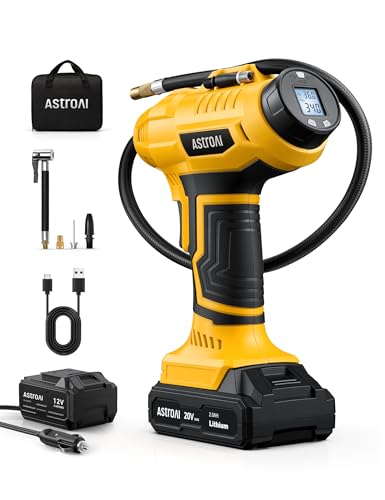
If cordless convenience is the main appeal, the AstroAI Portable Tire Inflator has a 4,000 mAh battery, which makes it easy to understand as an emergency trunk tool. For this particular need, it does not match the main list as closely because our top pick uses a 2-gallon tank and a 1/3 HP motor, a better fit for repeated driveway tire checks in cold weather.
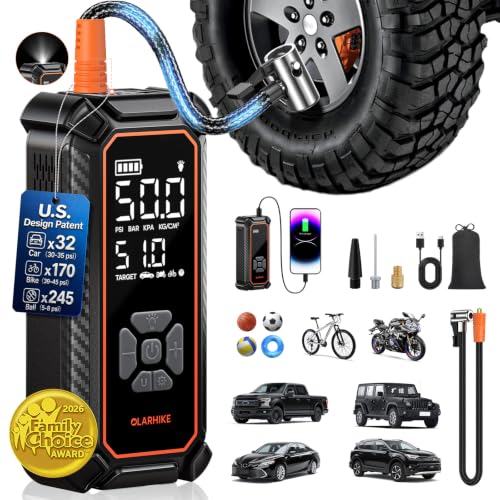
For shoppers who want more than one power option, the OlarHike Portable Tire Inflator combines a 12V connection with a 2,000 mAh battery. It also includes thermostat control, but its battery capacity is only half that of the 4,000 mAh AstroAI unit, and the main picks are more compressor-like in layout for home tire maintenance.
Moving up in battery size, the Craftsman Portable Tire Inflator has a 12V setup, a 6,000 mAh battery and thermostat control. That is the strongest battery number in this group of other options, but it is still a compact inflator rather than a tank-style compressor, so it did not displace our top pick for drivers who want a unit to keep near the garage.
And if a simple 12V plug is the whole reason you are shopping, the Carsun Portable Tire Inflator keeps things direct with 12V power and thermostat control. The trade-off is that it does not offer the 2-gallon or 3-gallon air reserve of the main picks, which is why it sits outside the main list for routine cold-weather tire pressure work.
FAQs
What size portable air compressor makes sense for cold-weather tire pressure?
For home tire maintenance, our picks range from 2 gallons to 3 gallons. That size is still portable, but it gives more reserve than a pocket-size inflator when several tires need attention.
Is a 12V inflator enough for winter tire top-offs?
A 12V inflator can work for small pressure corrections, and several other options use 12V power. The main picks lean toward tank-style compressors because a 2-gallon or 3-gallon reserve is more comfortable for repeated tire checks at home.
How much maximum pressure should I look for?
Our picks range from 110 PSI to 125 PSI. That gives more pressure headroom than typical passenger-vehicle tires require, which helps the compressor work without being right at its ceiling.
What winter safety step matters before using a compressor near a running vehicle?
According to the Centers for Disease Control and Prevention, a blocked tailpipe can cause carbon monoxide to build up quickly inside a vehicle. Before driving or working around a vehicle in snow, check that the tailpipe is clear.
Sources
- Clear Snow from Tailpipes, Centers for Disease Control and Prevention. CDC warning about snow-blocked vehicle tailpipes.
- Safety Guidelines: During & After a Winter Storm, Centers for Disease Control and Prevention. Winter heating safety for space heaters, kerosene heaters and carbon monoxide.





Write Your Review
No reviews yet. Be the first to share your experience!