

Free Delivery. Exclusive Deals. All Prime.
Prime members save on shipping and get first access to deals, plus Prime Video included. 30 days free.
The chairlift always seems to stop longest when your base layer is damp and your snack bar has frozen into a brick. Heated vests for skiing solve that by adding battery-powered warmth under a shell without adding sleeves. After comparing 2 models, the Soaccks Heated Vest is the strongest fit because it has a 16,000 mAh battery, up to 12 hours of heat, and heat up to 122°F. The Dr.Prepare Heated Vest is the alternative pick, with 3 heat settings and 10 heating zones.

Pros
- 16000 mAh battery pack lasts up to 12 hours
- 3 heat settings from 122 F to 150 F
- Independent front and rear heating controls
- Dual-side waist zippers adjust the fit
- Machine washable in a laundry bag
Cons
- Only Black color is listed
- Only Large-X-Large size is listed
- Machine washing requires a laundry bag
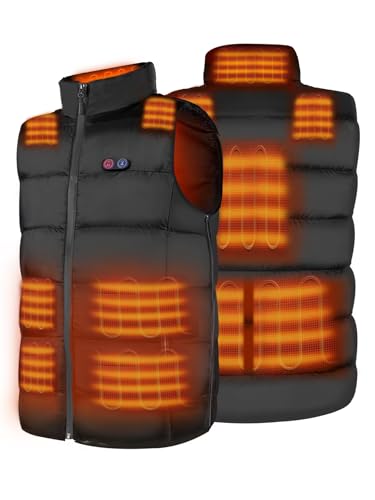
Pros
- 10 heating zones cover belly, back, waist, neck and shoulders
- 3 heating levels for adjustable warmth
- 2 buttons control front and back heat separately
- Side zippers add up to 5.5 inches of fit adjustment
- Machine wash and hand wash options
Cons
- Battery pack is not included
- Only listed in black
- Requires a portable power bank for heating
What Matters in Heated Vests for Skiing
Skiing asks more from a heated vest than a short dog walk or a chilly garage project. The vest has to work under layers, manage changing output as the day warms up, and keep its battery practical for long stretches outside.
- Battery capacity and run time: Battery size matters because lift lines, lunch breaks, and slow afternoons all eat into runtime. The Soaccks Heated Vest includes a 16,000 mAh battery and is rated for up to 12 hours of heat, which makes it the more complete main-list option for a full ski day. That upper runtime is most useful when you can drop the heat level between runs instead of leaving it at maximum all day. For this category, the best listings are clear about both capacity and runtime, not just one of those numbers.
- Heat settings and warm-up speed: Among our picks, heat controls run to 3 settings, which is the right baseline for changing conditions. A low setting helps once you are moving, while a higher setting can help during cold lift rides or standing around. One pick specifies warmth in 10 seconds, a useful number when you are already dressed and do not want to wait at the base area. Heat output also matters, and one main-list option states a range up to 150°F while another states up to 122°F.
- Heating zones and placement: The main-list vests use 10 to 12 heating zones, a meaningful spread for ski use because core warmth is more useful than hot spots at the edge of the garment. The zones cover areas such as the abdomen, waist, back, shoulders, and neck, depending on the vest. Front and rear controls are worth paying attention to because the wind on a lift does not always hit the same side of your body. A vest with more zones is not automatically better, but the placement should serve the core rather than just padding the feature count.
- Fit and layering room: A ski vest has to fit over a base layer and under a jacket without bunching. Our picks use side adjustment, and one provides 2.75 inches of extra space on each side. That matters when you change from a thin indoor layer to a thicker fleece before heading outside. Look for adjustment that changes the waist without leaving the vest loose at the torso, since heat transfers better when the vest sits close enough to the body.
- Water and wind resistance: Snow, chairlift mist, and wet gloves make weather resistance more than a comfort feature. One pick specifies windproof and waterproof materials, while the featured top pick is described as water resistant. Those claims do not replace a ski shell, but they help if the vest sees light moisture while you are adjusting layers or carrying gear. For skiing, a heated vest should be treated as a midlayer rather than the only outer barrier.
- Charging, care, and safety: One of our picks includes a battery pack, while the other requires a separate power bank. USB power is convenient, but the battery still needs to be matched to the vest’s requirements. Both picks allow machine washing with precautions, including using a laundry bag or securing the cable before washing. Safety is not a throwaway point: according to the U.S. Consumer Product Safety Commission, about 9,600 battery-heated jackets were recalled in the United States after a heated inner wrist cuff could overheat and pose a burn hazard.
We excluded disposable air-activated hand warmers because they are single use, non-heated thermal gear because it has no heating element, and replacement batteries or power banks sold alone because the safest choice is the battery the brand specifies. The remaining options below were compared for the same skiing priorities, especially capacity, heat duration, heating zones, and weather resistance.
The Competition
These are other heated vests we looked at but did not put on our main list.
If you want a simpler vest for damp cold, Soleilwear Heated Vest has a 10,000 mAh battery, 3 heat settings, and heat up to 104°F. It is water resistant, which helps for outdoor use, but its stated top temperature is lower than one main-list option and its battery capacity is below our top pick.
For shoppers who care more about a familiar heated-vest layout than maximum zone count, Ororo Heated Vest lists a 4,800 mAh battery, up to 10 hours of heat, and 4 heating zones. The runtime number is respectable, but the battery capacity is far below the 16,000 mAh figure on our top pick. Its 4 zones also cover less area than the 10 to 12 zone range among our main picks.
Higher heat is the reason to notice Kovnlo Heated Vest, which lists a 10,000 mAh battery, up to 6.5 hours of heat, and a temperature up to 149°F. That maximum temperature is close to the highest figure among our main-list options. The tradeoff is runtime, since up to 6.5 hours is shorter than the stated maximums for both main picks.
And if battery size is the whole reason you are shopping, Wasoto Heated Vest comes close to our top pick with a 16,000 mAh battery and up to 11 hours of heat. It lists 4 heating zones, though, which is much lower than the 10 to 12 zones on the main list. For skiing, that smaller zone count makes it less compelling when core coverage is the priority.
FAQs
How much battery capacity is useful for skiing?
For a ski day, a larger battery is easier to live with because cold, breaks, and long lift rides all reduce the margin for error. Our main picks include capacity up to 16,000 mAh, with stated heat duration up to 12 hours.
How many heat settings should a ski vest have?
Three heat settings are a practical baseline because you can start high, drop to medium while moving, and save low for milder stretches. Our picks use 3 settings, which keeps the controls simple enough to adjust between runs.
Where should the heating zones be for skiing?
Core placement matters most, especially around the abdomen, waist, back, shoulders, and neck. Our picks range from 10 to 12 heating zones, which gives broader coverage than options with only 4 zones.
Can a heated vest replace a ski jacket?
No, it should usually sit under a shell rather than replace one. Even when a vest is water resistant or made with waterproof material, a ski jacket still provides broader coverage against snow, wind, and abrasion.
Sources
- Columbia Sportswear Recalls Seven Models of Heated Jackets Due To Burn Hazard, U.S. Consumer Product Safety Commission. 2013 recall of battery-heated jackets whose heated wrist cuff could overheat.
- CPSC Warns Consumers to Immediately Stop Using iHeat Heated Insoles Due to Risk of Serious Burn Injury and Fire Hazard; Sold on Amazon, U.S. Consumer Product Safety Commission. July 2025 CPSC warning about battery-heated insoles sold on Amazon.




Write Your Review
No reviews yet. Be the first to share your experience!