

Try Amazon Prime free for 30 days
Fast free delivery on heavy items, plus Prime Video, Prime Music and member-only deal prices.
Today you’re going to learn everything there is to know about gas pressure washers: the best gas pressure washer brands and models and the three best gas pressure washers of 2022 for most people.
Let’s get started.
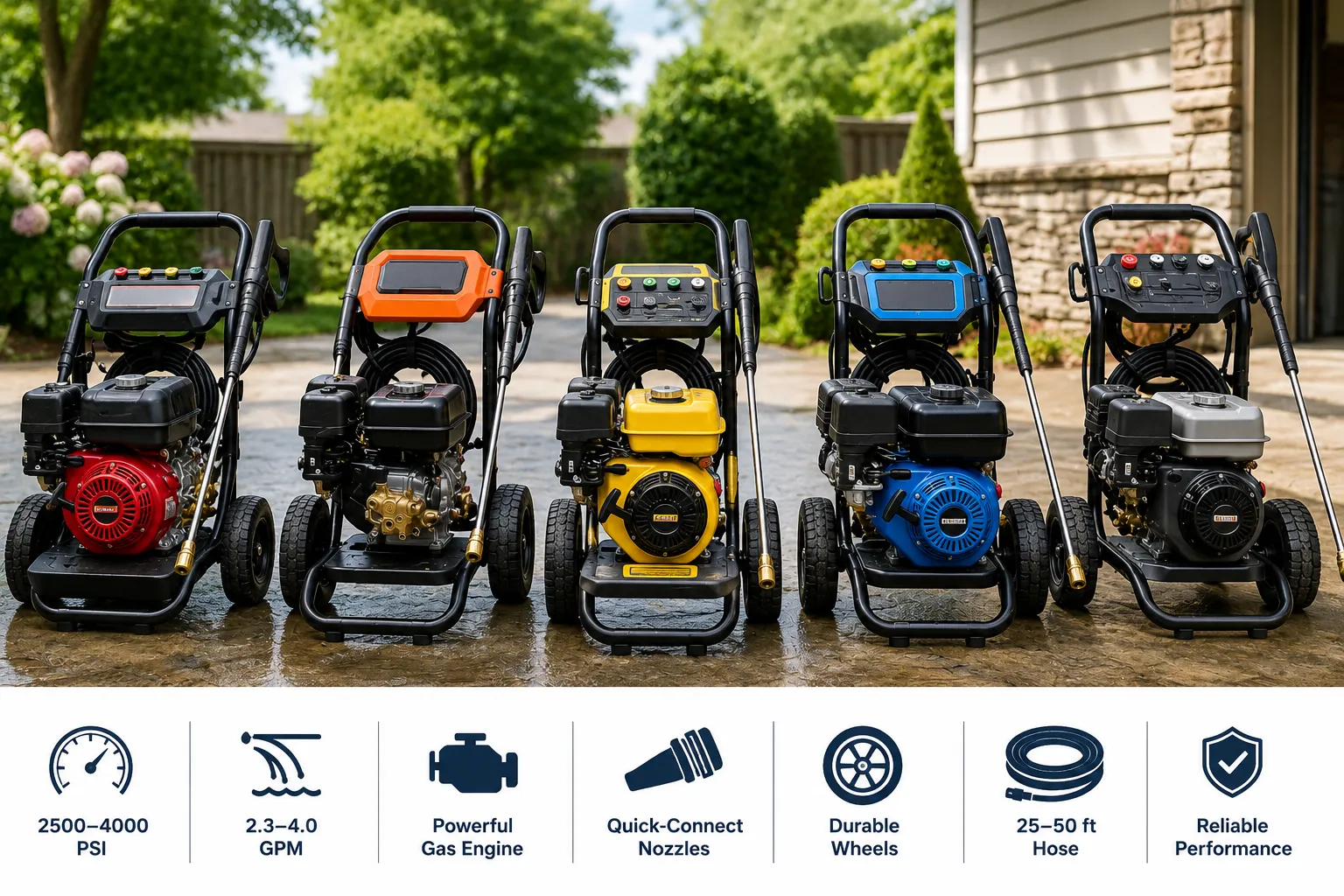
Gas power washers are more expensive than electric but they offer 3 main advantages:
- They are more powerful
- They are more durable
- They are more suited to job sites and remote areas because no electricity outlet required.
For these reasons, gas powered power equipment has always been, and still is, the go to style for contractors and professionals. However, over the years the gap between gas and electric has closed and now you can get a solid residential-use gas washer for very close to the same price as an upper range medium-duty electric.
If you already own a gas lawnmower, chainsaw, or other gas power equipment, getting a gas pressure washer makes sense.

Pros
- Hose doesn't kink after sitting in the sun all summer like cheaper brands
- Engine fires up first or second pull, even after sitting for weeks
- Thermal relief valve prevents pressure spikes that blow out seals
- Quick-connect fittings let you swap tips without fumbling with wrenches
Cons
- 2.5 GPM is slower than 3.0 GPM models, takes longer to rinse large driveways
- Cold water only, so you cannot strip mold from shaded areas as effectively
At 3400 PSI it strips algae off my deck in one pass and clears red clay mud from my driveway after Georgia storms, but it will not blast through years of paint buildup or tackle heavy industrial grime. The 2.5 GPM flow means you are spending more time rinsing than you would with a 3.0 GPM unit, which matters if you have a large driveway or you are impatient. The hose did not kink after sitting coiled in my garage all winter, and the engine started without drama every time I pulled it out, which is where cheaper machines fall apart. The four nozzles cover what a homeowner actually needs: soft wash for cars, medium spray for decks, and aggressive for concrete. One real limitation is that it is cold water only, so shaded areas with stubborn mold take longer to clean than they would with a heated unit, and you end up using more detergent to compensate.
Who should buy this: Get this if you clean your driveway and deck two or three times a year and want something that will not quit on you. Skip it if you have a 3000 square foot driveway that needs cleaning monthly, or if you are planning to strip old paint or blast heavy equipment. It is also solid for someone who borrows equipment to neighbors and wants something light enough to move around but tough enough to handle real work without breaking down.

Pros
- Nozzle system is genuinely intuitive, swaps in one second without fumbling
- Hose length and weight balance make it feel stable when you are holding it steady
- Thermal relief valve keeps it from overheating on long jobs, never had it shut down
- Steel frame and powder coat actually hold up, no rust spots after six months
Cons
- 0-degree nozzle is aggressive, stripped some stain off my fence before I switched to 25-degree
- 25-foot hose is limiting if your water source is far from the work area
I ran this on my patio after a Georgia pollen season and it cleared the algae buildup in one pass without needing to scrub afterward. The 3300 PSI hits hard enough to strip years of grime off concrete, but here is the thing: I had to respect the 0-degree nozzle. Pointed it at my garage floor where motor oil had settled, and it carved a groove before I realized what was happening. Switched to the 25-degree tip and it cleaned just fine without the aggression. The 2.4 GPM flow is steady, no pressure drops even when I was running it for three hours straight on a hot afternoon. DeWalt engine started on the second pull every time, which matters when you are not a small-engine mechanic and just want to grab it and go. Compact footprint actually fits in my workshop without taking up the whole bay.
Who should buy this: If you have a 0.5-acre lot with concrete driveways, wooden decks, and siding that needs cleaning once a season, this is the machine. It is not too heavy to maneuver solo, but it is serious enough that you won't outgrow it in a year. Skip it if you have a massive property or need to strip paint, because you will be frustrated with the flow rate and hose length. Also not the pick if your water source is more than 30 feet from your work area.

Pros
- Honda engine fires up first or second pull, even after sitting three weeks
- Hose is genuinely kink-resistant, doesn't tangle like cheaper brands
- Handles algae on my patio and red clay mud off the driveway without complaint
- Pneumatic tires roll smooth over gravel and rough ground
Cons
- 4000 PSI is overkill for house siding, you have to dial it back with the 40-degree tip
- Machine weighs enough that moving it solo gets old if you are cleaning a large property
The Honda engine is the real story here: it starts consistently, doesn't require the babying that cheaper knockoffs do, and the low oil shutdown feature kept me from torching the pump when I forgot to top off the tank one afternoon. At 4000 PSI with 3.5 GPM, this machine has enough muscle to strip years of algae and pollen buildup off my patio in one pass, and the 50-foot hose actually reaches my back fence without me dragging the whole rig across the yard three times. The triplex pump stays cool even when I am running it for hours on a hot Georgia day, which matters because I have seen cheaper units start sputtering when the thermal valve kicks in. One real limitation: you cannot just point this at your house siding and squeeze the trigger. The 4000 PSI will find every gap in the caulking and every soft spot in the wood, so you need to respect the nozzle selection and keep distance. If you are the type who wants to blast first and ask questions later, this will teach you a hard lesson.
Who should buy this: Anyone with a deck, patio, or driveway who wants to handle their own cleaning without renting equipment every spring. This is for someone who will actually use it monthly during the season, not a once-every-three-years deep clean. Skip this if you need to strip paint or clean a commercial parking lot; the 4000 PSI is not quite enough for that grind, and the machine is heavy enough that you will feel it by job three.

Pros
- Hose reel keeps the 32-footer from tangling up in your garage workshop
- 0-degree nozzle strips years of buildup off concrete in seconds without overheating the pump
- Pulls easy and starts first or second try, even after sitting three weeks between uses
- Heavy steel frame feels solid and doesn't rattle or flex under pressure like budget models
Cons
- Soap tank is small; you'll refill it twice washing a full truck and driveway
- Hose connection vibrates loose if you don't hand-tighten the coupling hard before firing it up
The 4.0 GPM flow keeps up with the pressure, so you're not waiting around watching water dribble down concrete. After a Georgia summer with pollen and algae all over the fence, this cleared it faster than my old 3000 PSI unit did. One real limitation: if you have a huge commercial driveway or need to strip old paint off a house, this will work but it'll take you all day and burn through fuel. It's built for a homeowner's 0.4-acre lot, not a contractor's job site.
Who should buy this: Get this if you have a driveway, patio, and fence that need cleaning once or twice a year and you want it done right without renting. Skip it if you're planning to pressure wash your neighbor's rental properties every weekend or if you have a weak water supply line, because the pump needs steady inlet pressure or it'll cavitate and fail early.

Pros
- Solid recoil start, fires up first or second pull even in heat
- Hose reaches far enough you rarely need to reposition the machine
- Nozzle tips quick-connect, swapping between 0 and 40 degrees takes seconds
- Pneumatic tires don't go flat like solid wheels do on gravel
Cons
- Soap tank is undersized, refill it twice washing a full-size truck
- Engine runs hot, needs 15 minutes to cool before you store it or risk fuel vapor lock
My driveway has that red clay staining that never fully comes clean, and this knocked it down to maybe 80 percent, which is honest work for a gas machine at this price point. The hose length keeps you from chasing the machine around your lot every five minutes, and the nozzles actually stay locked into the quick-connect instead of spinning loose like the knockoff brands I tried before. One real limitation: the engine temperature management is basic, so if you run it hard for 45 minutes straight in July heat, you need to let it cool before shutting down or you risk vapor lock in the fuel line. That is not a deal-breaker if you take a water break anyway.
Who should buy this: Homeowners with driveways, patios, or siding who wash their lot once or twice a season and want gas power without the weight or complexity of a commercial rig. Skip this if you have a massive property or plan to rent it out; the smaller tank and manual recoil start will wear on you fast. It is also solid for someone who wants to avoid the cord management nightmare of electric models but does not need a 5000+ PSI beast.

Pros
- Honda engine fires up first pull, even after sitting three months in the garage
- 50-foot hose reaches most of my lot without dragging the unit around constantly
- Thermal relief valve keeps the pump from overheating on hot Georgia afternoons
- Aluminum frame stays clean looking and does not rust like steel competitors after a season
Cons
- At 133 pounds, still heavy enough that loading into a truck bed gets old fast
- 4200 PSI can gouge wood if you get careless with the 0-degree tip on deck boards
This washer handles what most homeowners actually throw at it without breaking a sweat. The Honda engine starts every time you need it, and the 4200 PSI cuts through pollen-crusted Bermuda grass clippings on my driveway in one pass instead of three. The 50-foot hose is the real win here because you can set it up once and actually clean your whole property without dragging it around like a stubborn mule. The ceramic-coated pump parts mean it does not fall apart after one Georgia summer of humidity and heat the way cheaper units do. One thing to know: this much pressure will strip paint or gouge wood if you are not paying attention, so the five interchangeable tips are not just a convenience, they are necessary to keep from destroying what you are cleaning.
Who should buy this: Get this if you have a driveway, deck, or fence that needs real cleaning two or three times a year and you want something that will still work in five years. Skip it if you only wash your truck once a season or if you need a compact machine that fits in a corner; the weight and footprint make it more of a committed tool than a grab-and-go. Contractors who use pressure washers for work will appreciate the durability, but homeowners on a 0.4-acre lot like mine will find it does the job without being oversized.

Pros
- Pressure and flow together actually work, not one at the expense of the other
- Steel frame takes a beating without cracking or warping after a season
- Hose storage keeps things organized in the garage instead of tangled on the floor
- Pump sight glass beats guessing whether oil is contaminated with water
Cons
- Heavy enough that you think twice before pulling it out for a small patio job
- At this price point, you are buying commercial durability you may not need for weekend use
The pump handled detergent without choking, and the thermal relief kept it from overheating when I was switching between nozzles. Where it shows its commercial DNA is durability: the frame is welded steel that does not flex or rattle after months of use, and the hose has held up to being dragged across my garage floor and driveway without cracking or leaking. The one real limitation is that this machine is built for someone who uses it regularly, not someone who pulls it out twice a year; if you only need it occasionally, the weight and complexity become a hassle instead of a feature.
Who should buy this: Get this if you clean decks, driveways, or equipment as part of a regular routine and want something that will not fall apart mid-season. It is also the right choice if you are tired of renting or borrowing equipment and want to own something reliable enough that your neighbor actually wants to borrow it. Skip it if you have a small townhouse lot or only need to wash your truck a few times a year; the price and heft do not make sense for that kind of occasional use.

Pros
- Hose length saves dragging the machine across your whole yard repeatedly
- Nozzle variety handles concrete, siding, vehicles, and furniture without extra attachments
- Motor runs solid through a full season without bogging down or stalling
- Pneumatic tires actually roll smooth instead of fighting you on uneven ground
Cons
- Fuel tank is small, refills needed on jobs longer than 30 minutes of continuous use
- Soap tank capacity forces multiple refills when washing a full truck or long fence
This washer sits in that practical middle ground where it punches above its weight class without the complexity of bigger rigs. The 3500 PSI handles stubborn stuff like last year's pollen caked on my patio and the red clay splatter that sticks to my truck after Georgia storms. The 2.3 GPM flow keeps you from standing there all day rinsing, and the four nozzles mean you can actually use the right tool instead of guessing. Where it shows limits is runtime, the fuel tank empties in about half an hour of steady work, so if you are tackling a massive driveway or stripping paint off siding, you will be refueling mid-job. For a homeowner with a 0.4 to 0.5 acre lot who does this stuff every other weekend, the balance is right. The motor has held up through spring pollen, summer dust, and the kind of debris cleanup that follows Georgia thunderstorms without missing a beat.
Who should buy this: Anyone with a small to mid-size driveway, deck, or truck who wants to avoid electric models that undershoot the pressure needed for real cleaning. Skip it if you have a 3000 square foot driveway or need to strip old paint, because the tank size and flow rate will wear you out. Good fit for someone who stores equipment in a garage workshop and grabs it maybe once a month, because it is light enough to move around but serious enough to actually get the job done right.

Pros
- Hose length and wheel size make it practical for a full 0.4-acre property
- Engine starts reliably even after sitting through humid Georgia summers
- Nozzle variety means you can actually control the pressure instead of destroying surfaces
- Soap bottle attachment works without extra pumps or complicated setups
Cons
- 3.6L fuel tank empties faster than you'd think on heavy cleaning jobs
- Hose connection threads are tight out of the box, takes muscle to loosen
I used the 40-degree nozzle on my driveway and it handled the red clay stains from last month's storm, though if you've got really baked-on paint or concrete sealer you want stripped, you'll need to get closer or slower than feels comfortable. The engine doesn't bog down when you switch from the 40-degree to the 0-degree, which tells me the pump is sized right and not undersized like some budget units I've owned. One thing to know: the fuel tank is small enough that a full afternoon of cleaning means you're refueling mid-job, so if you've got a massive driveway or you're planning to rent this out, that's a real limitation.
Who should buy this: Get this if you've got a typical suburban lot in Georgia and you clean your driveway and deck a few times a year. It's the right size for someone who doesn't want to wrestle a 100-pound commercial unit around but needs actual power, not a toy. Skip it if you're planning to pressure wash your entire neighborhood or if you need to run it for hours without refueling.

Pros
- Pulls hard enough to strip years of Georgia red clay buildup in one pass
- Hose stays flexible in heat, no kinks after sitting in the sun all afternoon
- Soap nozzle actually works, mixes detergent without clogging or spraying air
- Recoil start beats electric cord hassle for a $309 machine
Cons
- 1-liter soap tank is a joke, refilled it twice washing my truck bed
- Manual choke takes practice if you have not run small engines before
I cleaned my truck, blasted the garage floor where my oil drips, and tackled the fence line in one afternoon without the machine bogging down or overheating. The real test came when my neighbor borrowed it to strip paint prep off his deck boards, and it handled that job without complaining. One thing to know: at this price point the pump is not commercial duty, so if you are planning to run it eight hours a day every day, this is not your machine. For a homeowner who pulls it out once a month or maybe twice during pollen season, this holds up.
Who should buy this: Get this if you have a small to medium lot with concrete, wood, and siding to maintain and do not want to spend a grand on a pressure washer. Skip it if you are doing professional paint prep work or cleaning rental properties where the machine runs all day. Also not the pick if you have a tiny yard and just need to rinse off your patio twice a year, because the gas engine and maintenance are overkill for that.
What To Look For In A Gas Power Washer
Gas pressure washers have internal combustion engines. The engine weighs at least 25 pounds (the total weight of most electric washers). So the most obvious thing about the gas style is they are bigger. Most have storage built-in for the pressure gun and spare nozzles. They have an either wheelbarrow like or hand truck stance and come with varying tire size and style.
Engine Size and Cleaning Power
Cleaning Power = Water Pressure (PSI) x Water Flow Rate (GPM)
Gas power washer engines’ size is defined in cubic centimeters (cc). The measurement describes the volume of the combustion chamber. Bigger the number, the more powerful the engine. More powerful the engine the higher the PSI.
The pump is typically described by flow rate in gallons per minute.
An example of 2 units with the same Cleaning Power but different PSI and GPM:
Unit 1:
- 3100 PSI x 3 GPM = 9300 Cleaning Power Units
Unit 2:
- 4000 PSI x 2.325 GPM = 9300 Cleaning Power Units
Electric Or Recoil Starter
Small internal combustion engines come with either electric or recoil starters (or both). Engines with the electric starter are more expensive.
Hot Water / Cold Water
Hot water power washers come with a heating element / boiler to heat the water up 140 F (50 C) above its current temp. Hot water easily rips through tough stains and breaks the soild bonds to clean with ease. Think about it: It’s why your dishwasher uses such hot water to clean the dishes.
Carriage Frame Construction
The bigger more powerful units take the wheelbarrow stance to make more room for the bigger engine and pump. The frame is welded steel and should incorporate vibration isolator engine mounting.
Tire Toughness
Look for heavy-duty pneumatic tires.
Storage Of Gasoline
Before you store your pressure washer for the winter be sure to empty the gas tank or add stabilizer to it.
Seasonal weather change causes stored gasoline to deteriorate, which can cause ignition issues within the combustion chamber of the pressure washer engine. Use fresh gasoline if you haven’t used your machine since last season. Gasoline should only be stored for 3-4 months in your garage in a Jerry can.
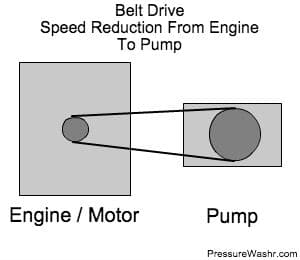
Direct-drive versus Belt-driven Pump
There are 2 different ways of driving your pressure washer pump: direct-drive and belt-drive. Both have their pros and cons:
- Direct-drive – Compact and more affordable but with extended (4+ hours/day) non-stop use can be prone to overheating the engine. Also tends to vibrate and cause more noise.
- Belt-drive – Requires more space to accommodate the belt and adding the belt means more maintenance and less efficiency. However, it reduces RPM and since the belt absorbs vibration it improves the life of the pump and engine. It also allows the unit to run at lower temperature and won’t overheat even with extended (8 hours/day) use.
The Best Gas Power Washer Brands
Simpson
The Simpson brand of pressure washer dominates the residential gas pressure washer market. Simply put: they make affordable, powerful and reliable units. In 2009 they reached a deal with The Black & Decker Corp (owners of the DeWalt trademark) to manufacture and sell their washers under the DeWalt name. Yes, this does mean that DeWalt and Simpson washers are exactly the same. In fact, they are made on the exact same assembly line in Decatur, Arkansas.
Generac
Generac has a long history in the residential power equipment market. They were the first to bring small size generators for home use to the market. Today they offer power washers as well.
A unique aspect of Generac washers is they make all their own engines. Simpson et al. use Honda, Kohler or Subaru engines. This gives Generac unique control of the design of their units. They like to brag about their engines being purpose-built for customer needs.
NorthStar
NorthStar is Northern Tool + Equipment’s home brand. The brand showed up on the market in 1991 and since then have become known has a high quality and great value.
Their gas pressure washers come in either cold or hot water style and the most affordable option is $549. They all use Honda GC or GX engines or Briggs and Stratton Vanguard.
Ryobi
Ryobi offers 6 different gas power washers ranging from 2,900 PSI to 3,600 PSI. They have either a Honda engine or Ryobi brand engine. Their 3,000 PSI, 2.3 GPM option is the most popular as its the one with the Honda GC engine.
BE
BE is a brand that originated in Abbotsford, Canada, and has now spread worldwide, selling pressure washers, water pumps, compressors, and generators. They offer 50 different models of gas pressure washers all the way up to an 8 GPM flow rate machine with 3,000 – 5,000 PSI. All their pressure washers have Honda engines, with the more expensive machines having the GX commercial engines.
Briggs & Stratton
Briggs & Stratton are the worlds largest supplier of small engines for power equipment, narrowly beating Honda in total small engine sales. They offer 113 different gas pressure washer models ranging from 2,200 PSI, 1.9 GPM to 3,700 PSI, 4.2 GPM.
Pressure Pro
If you’re a contractor that does pressure washing chances are you have used a Pressure Pro manufactured unit. Most of the skid mounted and commercial-duty units are Pressure Pro. They cost more than $750 in all cases.
Power And Price
What You Get For Below $300
There are only a few brand-new gas pressure washers that are sold for less than $300. They are from Generac and are medium-duty units.
What You Get For The Price Range $300 – $500
This is the most popular range of gas-powered pressure washers – the heavy-duty units tend to fall into this range. These units are 2x and 3x the cleaning power of the common electric pressure washers.
More Than $500
Most don’t need a pressure washer this powerful. But if you do, you’ll be getting a premium unit with huge potential. An example of a unit in the category is the 4,000 PSI and 4 GPM Pressure Pro with a 13hp GX390 Honda engine and CAT tiplex plunger pump. It costs $1,379.
Typical Warranty
When it comes to gas power cleaners the warranties are pretty standard across the board. The engines have 2-year limited warranty. And the rest of the unit has 1-year. In some cases things like the hose, pressure gun and nozzles are only covered for 90 days.
A limited warranty means they guarantee the unit is “free from manufacturer’s defects in material and workmanship.” So if your machine breaks and you take it to an authorized dealer the dealer decides if you broke it or if it was a defect caused from their poor manufacture, workmanship or materials used.
Most Affordable – Medium Duty Gas Pressure Washer
Generac 8874 2900 PSI 2.4 GPM Pressure Washer
This is one of the most affordable medium-duty gas pressure washers. It is the Generac SpeedWash with 2900 PSI and 2.4 GPM.
The reason it’s the most affordable is because it’s actually the least powerful gas powered unit on the market. It is comparable in price to the most expensive residential electric units by Karcher.
Generac is a well-known brand of pressure washers and portable and standby generators. They manufacture and design their own engines and pumps. People love this unit for its large diameter tires and upright, easy to move around design. It’s a great entry-level machine to have around the house. Great for all jobs given it comes with quick connect nozzles to vary the water pressures hitting the surfaces you’re cleaning.
Best Value – Heavy-duty Gas Pressure Washer
SIMPSON Cleaning PS3228 PowerShot
I’ve talked about the Simpson PowerShot a lot because it offers great value. For the money you get a triplex plunger pump and Honda GX200 commercial engine with a 3.1L fuel tank to last you 2-3 hours of non-stop washing.
As you can see it has the large pneumatic tires to make moving around terrain easy. It’s hard to see from the product image but this machine is quite compact and low profile. It’s definitely smaller than your wheelbarrow in terms of storage space required.
Compared to the most affordable heavy-duty it is about 2x the price. But to put that in perspective it also boast 56% more cleaning power and comes with premium parts like the commercial engine and longer lasting triplex pump system. All-in-all this is the pick for the best value for the money in the heavy-duty category.
Best Performance – Heavy-duty / Commercial Belt-drive Gas Pressure Washer
Pressure Pro E4040HG Heavy Duty Professional
It’s not really fair to place the Pressure Pro into the heavy-duty category when comparing for performance. It is simply a machine in another league than the ones above. It has a belt-driven pump. And it’s driven by a Honda GX390 engine. Yep, almost double the size engine of the best value Simpson above.
Pressure-Pro makes their washers with either Annovi Reverberi or CAT brand pumps. Both are premium and both will be triplex plunger style. Whichever you choose, you’ll end up paying a higher price for this commercial everyday-all-day use machine.
Sources
- Quora answer by Chemical Engineer Ryan Carlyle on petrol storage.
- Hotsy has a useful page on direct-drive vs belt-drive in pressure washers.



Write Your Review
No reviews yet. Be the first to share your experience!