

Try Amazon Prime free for 30 days
Fast free delivery on heavy items, plus Prime Video, Prime Music and member-only deal prices.
When one end of the sofa feels like a walk-in freezer and the thermostat argument has already begun, energy efficient infrared space heaters can warm the room you are actually using. After comparing 6 models, the Kegian Infrared Heater stands out for 1,500 watts, a 1000-watt low setting and tip-over plus overheat protection. The Dr. Infrared Heater DR-123 is the alternative pick, with 1,500 watts and an adjustable thermostat.

Pros
- 1000W and 1500W power settings
- Thermostat range from 50°F to 95°F
- 12-hour timer with auto shut-off
- Child lock, tip-over, and overheat protection
- Remote, handle, and wheels for easier control and moving
Cons
- Requires a grounded 15A or higher outlet
- Heating area size is not specified
- Do not touch the handle while the heater is heating

Pros
- 1500W dual infrared quartz and PTC fan-forced heat
- 3 modes, Eco, High and Low
- Digital thermostat adjusts from 30°F to 99°F
- 12-hour timer and remote control included
- Tip-over and overheat protection with auto shut-off
Cons
- Heating area is not specified
- 18 lb weight may be bulky to lift
- Remote needs 2 AAA batteries, not included

Pros
- 1500 watts with 5200 BTU heat output
- Two power modes, 750 watts and 1500 watts
- Wall mount or floor use with removable feet
- Built in thermostat with LED display
- Remote control included
Cons
- Intended for a small room or office
- No heating area in square feet listed
- At 9 pounds, it is not the lightest portable heater
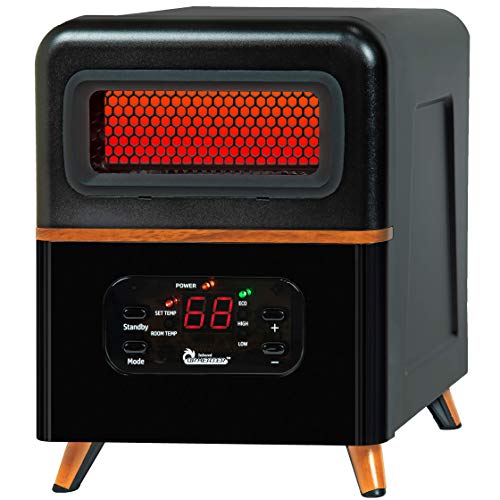
Pros
- 1500W high and 1200W low heat settings
- 5200 BTU/hour heat rating
- Thermostat range from 50 to 86F
- 12-hour timer and remote control
- UL and cUL certified with tip-over and overheat shutoff
Cons
- Heating area is not specified
- 10 lb weight may be less convenient to move
- No oscillation feature is listed

Pros
- 1500W infrared heat with 5200 BTU output
- Heats up to 350 sq ft
- Four infrared quartz elements heat up in 3 seconds
- 9-hour programmable timer and thermostat
- TUV certified with overheat auto shut-off
Cons
- Coverage is limited to rooms up to 350 sq ft
- Remote needs 2 AAA batteries, not included
- 18.8 lb weight may be less easy to move

Pros
- 1500W dual infrared quartz tube and PTC heating
- Cool mist ultrasonic humidifier built in
- Oscillation helps distribute heat through the room
- Digital thermostat adjusts from 50°F to 85°F
- Tip over and overheat protection included
Cons
- 26 lb weight may be bulky despite wheels
- Zone heating design is not for heating the whole house
- Thermostat range tops out at 85°F
What Matters in Energy Efficient Infrared Heaters
Room heaters are simple only until you start comparing wattage, shutoffs and controls. For this category, the better fit is usually the model that can deliver enough heat on its high setting, then step down before it wastes power or overheats the space.
- Heat output for the room size: Most picks use a 1,500-watt high setting, which is the common ceiling for plug-in electric space heaters. The Kegian Infrared Heater also has a 1000-watt low setting, so it can run below full power once the room is comfortable. That matters for zone heating, because the goal is warming 1 occupied room instead of pushing the central thermostat higher.
- Tip-over, overheat protection and certification: Tip-over and overheat shutoffs were treated as baseline safety features, not bonuses. The Dr. Infrared Heater DR-978 combines tip-over protection, overheat shutoff and UL certification, and its settings include a 1,500-watt high mode with a 1200-watt low mode. According to the U.S. Consumer Product Safety Commission, electric heaters need an automatic cut-off if they tip over, and heaters should be certified by a nationally recognized testing laboratory.
- Thermostat range and controls: A thermostat lets a heater cycle instead of running continuously. Among the main picks, thermostat ranges include 50 to 86°F, 50 to 85°F and 30 to 99°F, while timer limits run from 9 hours to 12 hours. Remote controls also matter if the heater will sit across a bedroom or office, since changing the setting should not require walking over every time.
- Noise level: Infrared heaters can still make noise when they use a fan or blower. One main pick specifies operation under 45 dB, while another uses a fanless convection design. If the heater is mainly for sleep or focused work, that sub-45 dB figure gives a clearer expectation than a general quiet claim.
- Oscillation and heat spread: Heat spread depends on more than wattage. The Wewarm 5,200 BTU Infrared Heater is rated at 5,200 BTU and up to 350 square feet, which gives shoppers a room-size reference beyond its 1,500-watt rating. Another pick adds oscillation, which can help distribute warmth across more than 1 seating position.
- Size, weight and portability: Portability matters because zone heating works best when the heater can follow you from room to room. Main-list features include caster wheels, carry handles and wall-mountable designs, with timer controls of up to 12 hours on several picks. For a heater that moves daily, wheels can be more important than cabinet styling.
Central furnaces and whole-house systems were excluded because they require professional installation and solve a different problem. Water heaters and heated blankets were also left out because they do not heat a room, and unvented fuel heaters without an indoor rating were excluded because of carbon monoxide risk indoors.
Other Infrared Heaters Worth Considering
These are other infrared heaters we looked at but did not put on our main list.
If you want a familiar 1,500-watt ceiling with a lower-power mode, the RealSmart Infrared Heater has a 750-watt low setting and is rated for up to 350 square feet. Its drawback is portability, since it weighs 16 pounds versus 10.4 pounds for our top pick.
For a much smaller heat source, the FrauSonne Infrared Heater runs at 350 watts. That is far below the 1,500 watts of our top pick, so it makes more sense for very targeted personal warmth than for a larger room.
Anyone who wants a cabinet-style heater may also look at the Dr. Infrared Heater DR-968, which lists 1,500 watts and 5,200 BTU. It includes an adjustable thermostat plus tip-over and overheat protection, but its 19-pound weight makes it much heavier than our top pick at 10.4 pounds.
At the lighter end, the Wewarm Infrared Heater weighs 6.4 pounds and has a 1000-watt low setting below its 1,500-watt high setting. It is rated for up to 300 square feet, which is 50 square feet less than the largest room rating noted among the alternatives.
FAQs
Are infrared heaters more energy efficient than other space heaters?
Electric resistance heaters generally turn electricity into heat at the point of use, so efficiency depends heavily on how you use them. A 1,500-watt infrared heater can save energy only if it lets you heat 1 occupied room instead of raising the temperature for the whole home.
What safety features matter most for an infrared heater?
Look for tip-over shutoff and overheat protection first. The U.S. Consumer Product Safety Commission says an automatic cut-off is required to turn off electric or kerosene heaters if they tip over, and it also recommends certification by a nationally recognized testing laboratory.
How far should an infrared space heater be from furniture or bedding?
The U.S. Fire Administration says to keep anything that can burn at least 3 feet from space heaters. The Centers for Disease Control and Prevention gives the same 3-foot guidance for drapes, furniture and bedding, and says never to cover a space heater.
Do timer and thermostat controls really help reduce energy use?
They can, as long as the heater is sized for the room and used for zone heating. Among our picks, timers run from 9 hours to 12 hours, and thermostat ranges include settings as low as 30°F and as high as 99°F.
Sources
- CPSC Offers Tips to Prevent Home Fires From Space Heaters, U.S. Consumer Product Safety Commission. Fire-safety tips and required safety features for space heaters.
- Heating Fire Safety, U.S. Fire Administration. Home heating fire statistics and prevention messages.
- Safety Guidelines: During & After a Winter Storm, Centers for Disease Control and Prevention. Winter heating safety for space heaters, kerosene heaters and carbon monoxide.




Write Your Review
No reviews yet. Be the first to share your experience!