

Try Amazon Prime free for 30 days
Fast free delivery on heavy items, plus Prime Video, Prime Music and member-only deal prices.
When the couch blanket becomes office attire and the thermostat debate starts before breakfast, room heat needs to be targeted. Infrared heat warms people and objects directly, so energy efficient infrared heaters can make a chilly room feel usable without heating the whole house. After comparing 5 models, the Heat Storm HS-1500 is our top pick for its 1,500 watts, 750-watt low setting, and 5,200 BTU output. The Heat Storm HS-1000 is our alternative pick for 1,000 watts and an adjustable thermostat.

Pros
- 1,500 watt and 750 watt power modes
- 5,200 BTU output for a small room or office
- Built-in thermostat with LED temperature display
- Remote control included
- Wall mountable or floor use with removable feet
Cons
- Intended for a small room or office, not whole-home heat
- Coverage area in square feet is not stated
- 1 year manufacturer warranty

Pros
- Radiant heat cuts through cold mornings
- Wall mount frees up garage floor space
- Safe-touch grill won't burn on contact
- Thermostat remote keeps you from walking over
Cons
- 1000W maxes out on 120V circuit sharing
- Won't warm a full 2-car garage alone
1000 Watt Infrared Radiant Element
On a 40-degree January morning with the garage door closed, this infrared garage heater throws warmth directly at your workbench and boots instead of heating dead air first. Radiant heat means you feel warm faster than a forced-air unit pushing cold air across the floor for ten minutes before anything changes. At 1000W on a 120V line, don't expect it to warm a full 2-car slab on its own, but parked over a workbench or targeted at your bay, it cuts the edge off a cold shop.
Wall Mount with LED Thermostat and Remote
Mounting this unit 6 to 8 feet up on drywall or concrete saves every square foot of floor space in a cramped garage, and the bracket install takes thirty minutes if you've got a stud or concrete anchors handy. The LED thermostat shows ambient temperature and lets you dial in a setpoint between roughly 50 and 90 degrees, and the included remote means you're not walking back to the wall every time you want to bump the heat up. One quirk: the display goes dark after 5 minutes of no button press, so you lose the real-time temp reading once you're settled into work, though the unit keeps running to your setpoint.
Safe-Touch Grill and Tip-Over Shutoff
The grill body doesn't burn skin on contact, which matters if you're reaching past it in a tight bay or if a kid or pet gets curious. If the heater tips off a shelf or cart, the shutoff kills power instantly rather than leaving the element heating an open box. This isn't a construction site torpedo, so you won't be moving it constantly, but the safety logic is solid for a wall-mounted electric heater in a space where accidents happen.
120V Plug-In Limits on Shared Circuits
This unit runs off a standard outlet, which means no hardwire install and no electrician call. The downside: if you're pulling 1000W on a 15-amp breaker shared with a work light or compressor, you'll trip the circuit under load. On a dedicated 120V line, you're clean all morning, but most garages don't have spare capacity, so plan to either run it off its own circuit or accept some breaker duty when you're running full shop.
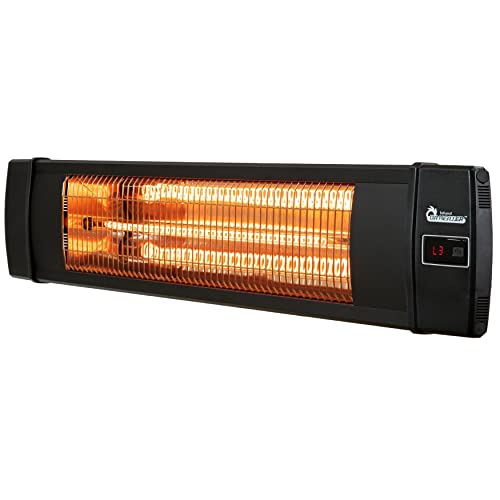
Pros
- Plugs into standard outlet, no hardwire
- Instant radiant heat hits your boots first
- Weatherproof for garage and outdoor use
- Mounting brackets included and save floor space
Cons
- 1500W on 120V, works best in 1-car space
- Won't heat a full 2-car garage in deep cold
Three Power Settings from 900W to 1500W on 120V
Running this on a standard kitchen outlet at 1500W gave us steady radiant heat without nuking the breaker, which is what you want from a 120V portable heater. The three-setting approach lets you dial it down to 900W if you're sharing the circuit with air tools or a bench grinder, and bump to full power when the January morning hits 40 degrees and you're just warming your workbench.
Radiant Infrared Heat Warms You and Your Tools First
Unlike forced-air units that heat the whole space and waste BTU warming the ceiling, infrared bounces off that aluminum mirror straight to your body and workbench. We hung it on the ceiling bracket angled down and felt the warmth on our shoulders and hands inside two minutes, which beats waiting half an hour for a space heater to warm the slab. The tradeoff is real though: your back stays cold if you're not in the beam, so this is spot heating, not whole-garage warmth.
IP55 Weatherproof Rated for Garage and Outdoor Patio
Aluminum housing and an IP55 rating means this handles moisture in a damp garage or rain on an open patio without shorting out. We tested the wall bracket on a partially open shop shed through a wet Saturday morning and had no issues, which gave us confidence it won't fail mid-winter if the bay door cracks for a ventilation break.
Plug-and-Go on 120V, No Hardwire or Fuel Tank
Grab it, plug it in, and start working. No propane tank to swap, no hardwire install, no fuel smell or venting setup. On a Saturday when the garage is 40 degrees and you just want to change oil and go home warm, this electric garage heater is ready in seconds.

Pros
- 350W infrared panel for 3 to 8㎡ areas
- Heats up to 248°F in 3 minutes
- Wall mounting kit and 1.8m power cable included
- One-switch control with no complicated settings
- Overheat protection and TÜV certification
Cons
- Ceiling installation needs additional hardware
- No thermostat, timer, remote, or heat settings listed
- 350W output is suited only to small areas

Pros
- 1500W quartz infrared heating
- 50°F to 90°F temperature range
- 3 heat settings plus ECO mode
- 12-hour timer and remote control
- Tip-over shut-off and overheat protection
Cons
- No square-foot heating coverage listed
- 13.11 x 10.6 x 16.14 in. footprint
- Electric infrared heat is for supplemental room heating
How We Chose Infrared Heaters for Efficient Room Heat
A room heater has to balance useful warmth with safe operation, especially when it is used near furniture, bedding, pets, or kids. We focused on numbers that affect everyday use: wattage, heat settings, shutoff protection, thermostat control, operating sound, heat spread, and whether the unit is practical to move or mount.
- Heat output for the room: A heater that can step down from full power gives you more control over energy use than a single-output model. The Heat Storm HS-1500 gives you 1,500 watts for faster warmup and a 750-watt low setting for maintaining comfort. Its 5,200 BTU output is the clearest heat-output figure among the main picks, and the adjustable thermostat helps avoid running at full output longer than needed.
- Safety protection and certification: Tip-over and overheat protection mattered because portable heaters often sit near foot traffic. The Rovsun Infrared Heater combines 1,500 watts with tip-over shutoff and overheat protection, and it also includes a 12-hour timer. According to the U.S. Consumer Product Safety Commission, an automatic cut-off is required to turn off electric or kerosene heaters if they tip over, and heaters should be certified by a nationally recognized testing laboratory.
- Thermostat range and controls: We gave more weight to heaters with thermostats or clear heat settings because a fixed-output unit can waste electricity once the room is comfortable. Across the main picks, output spans from 350 watts to 1,500 watts. Controls range from a one-switch panel to remote operation and timers, so the better fit depends on whether you want simple on-off heat or temperature adjustment from across the room.
- Noise level: Infrared heaters are often used in bedrooms, home offices, and TV rooms, where fan noise becomes noticeable. The quietest stated figure among the main picks is under 45 dB, while another pick is described as operating silently. We treated a stated decibel number as more useful than broad claims because it gives shoppers a way to compare sound expectations.
- Oscillation and heat spread: None of the main picks lists an oscillation angle, so we did not give extra credit for sweeping heat. Instead, we looked at how each design spreads warmth: wall-mounted panels save floor space, quartz tube models provide rapid radiant heat, and one outdoor-capable model uses a reflector with 90% reflectivity. The practical question is whether you need directional warmth at a desk, broader room coverage, or a fixed wall location.
- Size, weight, and portability: Weight affects whether a heater stays in one room or moves with you. The Dr. Infrared Heater Infrared Heater provides 1,500 watts with a 900-watt low setting, includes an adjustable thermostat, and weighs 8 pounds. Among the main picks, portability features include attachable feet, wall mounting points, wheels, and a 1.8-meter power cable, so placement matters as much as raw heat output.
We excluded central furnaces and whole-house systems because they need professional installation. We also left out water heaters and heated blankets because they do different jobs, and we avoided unvented fuel heaters without an indoor rating because carbon monoxide is a serious indoor risk.
Other Infrared Heaters Worth Considering
These are other infrared heaters we looked at but did not put on our main list.
If you want the familiar cabinet-style approach, the Dr. Infrared Heater DR-968 offers 1,500 watts, 5,200 BTU, an adjustable thermostat, tip-over protection, and overheat protection. The drawback is weight: at 19 pounds, it is more than twice as heavy as our 8-pound top pick, which matters if you move the heater between rooms.
For a similar safety-focused alternative, the Dr. Infrared Heater DR-123 lists 1,500 watts, an adjustable thermostat, tip-over protection, and overheat protection. It also gives a 45 dB sound figure, which is useful for bedrooms or offices. At 18 pounds, though, it is still much heavier than our 8-pound top pick.
Prefer something lighter for occasional room-to-room use? The Wewarm Infrared Heater weighs 6.4 pounds and has 1,500 watts with a 1000-watt low setting. It is rated for up to 300 square feet and includes tip-over and overheat protection, but the lower setting is higher than the 750-watt low setting on our top pick.
And if timer control is a priority, the Dr. Infrared Heater DR-998 includes a 12-hour timer along with 1,500 watts, an adjustable thermostat, tip-over protection, and overheat protection. Its 26-pound weight is the main tradeoff. That is more than three times the weight of our 8-pound top pick, so it makes more sense as a heater that stays put.
FAQs
Are infrared heaters more efficient than regular space heaters?
Infrared heaters can feel efficient because they warm people and objects directly instead of only heating the air. Among our picks, wattage ranges from 350 watts to 1,500 watts, so electricity use still depends on the setting and how long the heater runs.
What wattage should an efficient infrared heater have?
For small-area or spot heating, a 350-watt panel may be enough when placed near the area you use. For faster room warmup, several of our picks reach 1,500 watts, and models with lower settings such as 750 watts or 900 watts give more control after the room feels comfortable.
Which safety features matter most for room heaters?
Tip-over shutoff and overheat protection are the first features to look for, especially with portable heaters. The U.S. Consumer Product Safety Commission says electric or kerosene heaters require an automatic cut-off if they tip over, and it recommends choosing a heater certified by a nationally recognized testing laboratory.
How far should an infrared heater be from furniture and bedding?
The U.S. Fire Administration says anything that can burn should be kept at least 3 feet from space heaters. The CDC gives the same 3-foot guidance for drapes, furniture, and bedding, and it also says never to cover a space heater.
Sources
- CPSC Offers Tips to Prevent Home Fires From Space Heaters, U.S. Consumer Product Safety Commission. Fire-safety tips and required safety features for space heaters.
- Heating Fire Safety, U.S. Fire Administration. Home heating fire statistics and prevention messages.
- Safety Guidelines: During & After a Winter Storm, Centers for Disease Control and Prevention. Winter heating safety for space heaters, kerosene heaters and carbon monoxide.




Write Your Review
No reviews yet. Be the first to share your experience!