

Try Amazon Prime free for 30 days
Fast free delivery on heavy items, plus Prime Video, Prime Music and member-only deal prices.
Your office thermostat swears the room is comfortable, yet your fingers are typing like they spent the morning in a freezer. Compact 1000 watt space heaters fix that by warming the small zone around your desk or chair instead of the whole floor. After comparing 4 models, the Comfort Zone Ceramic Heater is the best fit: it delivers 1,000 watts with a 700-watt low setting, weighs 1.6 pounds and cuts power if it tips over. The Aiwa Ceramic Heater is the alternative, matching those 1,000 watts with an adjustable thermostat.

Pros
- 2 heat settings, 700W and 1000W
- Adjustable thermostat with manual knob
- Fan only setting for air circulation
- Tip over switch and overheat protection
- Compact 5.51 x 3.94 x 7.6 inch desktop size
Cons
- Designed for localized personal warmth, not large rooms
- Manual knob thermostat, no digital temperature display
- 1000W maximum output is modest for a space heater

Pros
- 1000W ceramic heat in a compact design
- Adjustable thermostat for heat control
- Fan-only mode for air circulation
- Tip-over shutoff and overheat protection
- ETL certified with a 6 ft UL-listed cord
Cons
- Best suited to desktops, under desks, and personal areas
- No timer or remote listed
- No oscillation feature listed

Pros
- 1000W high heat and 400W low heat settings
- PTC ceramic element reaches 140°F in 2 seconds
- 45° tip-over shutoff and overheat protection
- 4W fan mode for light airflow
- Compact 5.4 x 6.3 x 6.3 inch size
Cons
- Best suited to personal or small-space heating
- No thermostat listed in the product data
- No oscillation or timer listed in the product data

Pros
- 500 to 1000 watts
- Tip-over shutoff and child lock
- Safe-to-touch grill
- Built-in thermostat with LED display
- Remote control included
Cons
- Heating coverage is not listed
- No noise level listed
- Wall mount still needs under 2 sq ft of wall space
What We Looked For in 1000 Watt Space Heaters
A 1,000-watt heater puts out about two-thirds the heat of the 1,500-watt models we passed on, so it has to make every watt count in a small space. That meant judging each one on how it delivers heat, how it protects you and how easy it is to live with every day.
- Heat output and settings: All 4 of our picks top out at 1,000 watts, and three of them list a low setting that runs from 400 to 700 watts. A lower setting keeps a cubicle or small bedroom comfortable once it has warmed up, instead of cycling between too hot and too cold. The Comfort Zone Ceramic Heater pairs its 1,000-watt high with a 700-watt low, the narrowest gap of the group, so dropping to low still leaves real warmth at a desk. For room size, one rival we looked at rates its 1,000-watt unit for up to 200 square feet, a useful ceiling for this class.
- Tip-over, overheat and certification: All 4 picks shut off if knocked over, and the U.S. Consumer Product Safety Commission says an automatic cut-off is required for electric heaters that tip. Three of them also list overheat protection, and one lists ETL certification with a 6-foot UL-listed cord, in line with the CPSC advice to choose a heater certified by a nationally recognized testing laboratory. The Gaiatop Space Heater goes furthest, with 4 separate safety measures. Its tip-over switch trips at 45 degrees, and overheat protection guards the 1,000-watt element. It also uses V0 flame-retardant materials and adds an independent on/off safety switch.
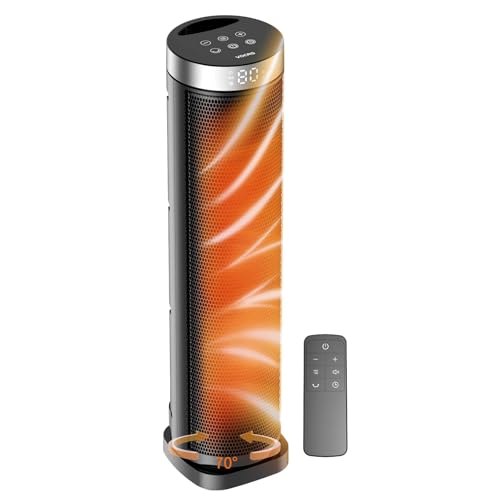
- Thermostat and controls: Three of our 4 picks have an adjustable thermostat, which holds a set temperature rather than running flat out until you remember to switch it off. The fourth relies on 3 modes instead: high heat, low heat and fan. The Heat Storm Infrared Heater has the most complete controls, with a digital touch-screen thermostat and an LED display of the room temperature. It adjusts between 500 and 1,000 watts, and it adds a remote control and a child lock for bedrooms shared with small hands.
- Noise level: None of our 4 picks publishes a decibel figure, so this point comes down to design. Three of them are fan-forced ceramic heaters, and comparable heaters we looked at list between 34 and 43 dB. Treat anything near the low end of that range as quiet enough for a bedroom or a video call.
- Oscillation and heat spread: None of our 4 picks oscillates, so each one sends heat in a single direction. That suits personal heating: aim it at your legs or chair and keep it pointed there. Both the U.S. Fire Administration and the CDC say to keep anything that can burn at least 3 feet away, which also gives the warm air room to spread.
- Size, weight and portability: Our top pick weighs 1.6 pounds and has a recessed handle for moving it from desk to bedside. The smallest desktop pick measures 7.6 by 3.9 by 5.5 inches, small enough for a countertop or the floor under a desk. The wall-mount option uses less than 2 square feet of wall space and can hide its cord when mounted over a standard 110V outlet.
We left out central furnaces and whole-house systems, since they need professional installation and do a different job from a plug-in heater. Water heaters and heated blankets were also off the table. We skipped unvented fuel heaters without an indoor rating, because they carry a carbon monoxide risk indoors. If none of our 4 picks suits your space, a few other models came close.
The Competition
These are other space heaters we looked at but did not put on our main list.
If you want the same output as our top pick with a stated room rating, the BZGG Space Heater runs at 1,000 watts with a 700-watt low setting and is rated for up to 200 square feet. It lists 40 dB, adds tip-over and overheat protection, and offers a different design and feature mix at a similar heat output.
Need more heat than any 1,000-watt model can give? The Amazon Basics Ceramic Heater climbs to 1,500 watts with a 900-watt low setting, and it lists 43 dB with tip-over and overheat protection. Its low setting alone is close to the full output of our alternative pick, which is more than a desk or small bedroom needs.
A similar story applies to the Fanspex Space Heater, which pairs 1,500 watts with a 750-watt low setting, an adjustable thermostat and ETL certification. It is a capable unit, but at 500 watts above our picks it is aimed at larger rooms rather than personal heating.
And if a quiet bedroom is the whole reason you are shopping, the Dreo Space Heater lists 34 dB, the lowest figure we saw. It also runs at 1,500 watts with an adjustable thermostat and tip-over and overheat protection, which puts it outside the 1,000-watt class this list focuses on.
FAQs
Is 1,000 watts enough to heat a bedroom?
For a small bedroom or office, usually yes. One 1,000-watt rival we looked at is rated for up to 200 square feet, and our picks offer low settings from 400 to 700 watts to hold the temperature once the room is warm. Larger or drafty rooms are better served by a 1,500-watt heater.
Can I leave a 1000-watt space heater on overnight?
The U.S. Fire Administration says to turn space heaters off when you leave the room or go to bed. It also notes that portable heaters caused only 3 percent of home heating fires from 2017 to 2019 but 41 percent of fatal ones. Tip-over and overheat shutoffs help, but they do not replace switching the heater off.
How far should a small space heater sit from furniture?
The CPSC, the U.S. Fire Administration and the CDC all advise keeping heaters at least 3 feet from bedding, drapes and furniture. The CPSC adds that the heater should sit on a level, hard, nonflammable surface, not on a rug or carpet. The CDC also warns never to cover a space heater.
Does a 1000-watt heater use less electricity than a 1,500-watt model?
At full power, it draws 1 kilowatt-hour per hour of use versus 1.5 for a 1,500-watt heater, about one-third less. A thermostat or low setting cuts that further, since the heater stops drawing full power once the room reaches your set temperature.
Sources
- CPSC Offers Tips to Prevent Home Fires From Space Heaters, U.S. Consumer Product Safety Commission. Fire-safety tips and required safety features for space heaters.
- Heating Fire Safety, U.S. Fire Administration. Home heating fire statistics and prevention messages.
- Safety Guidelines: During & After a Winter Storm, Centers for Disease Control and Prevention. Winter heating safety for space heaters, kerosene heaters and carbon monoxide.




Write Your Review
No reviews yet. Be the first to share your experience!