

Try Amazon Prime free for 30 days
Fast free delivery on heavy items, plus Prime Video, Prime Music and member-only deal prices.
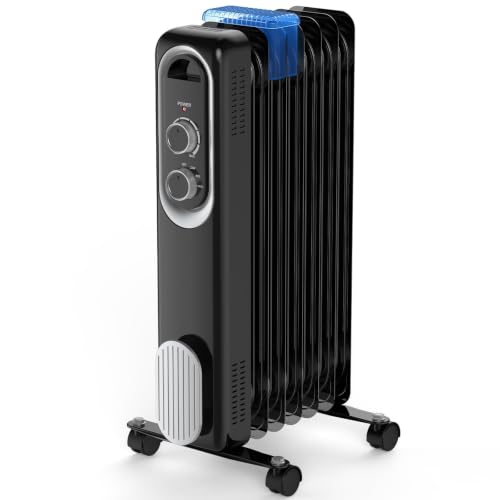
You turn up the thermostat for one cold home office, and the whole house pays for it, including the empty guest room the cat now treats as a sauna. Space heaters that use the least electricity fix that by warming only the room you are sitting in. After comparing 6 models, the Amazon Basics Oil-Filled Radiator is our top pick: it drops to a 600-watt low setting, covers up to 144 square feet, and adds tip-over and overheat protection. For a single desk, the Amazon Basics Ceramic Heater draws just 500 watts with tip-over protection.

Pros
- 3 heat settings, 1500W, 1000W, and 600W
- 7 oil-filled steel fins heat up to 144 sq ft
- Tip-over and overheat protection, ETL certified
- Quiet operation with no fan noise
- Caster wheels and handle for room-to-room movement
Cons
- Heats only up to 144 sq ft
- 17.42 lb weight may be bulky to lift
- No fan for direct airflow

Pros
- 500W ceramic heat warms in seconds
- 48dB noise rating
- Tip-over protection shuts heater off if knocked over
- Compact 5.87 x 3.15 x 5.95 inch size
- Lightweight 1.4 lb design
Cons
- 500W is best for close-range personal warmth
- No thermostat listed in the product data
- No overheat protection listed in the product data

Pros
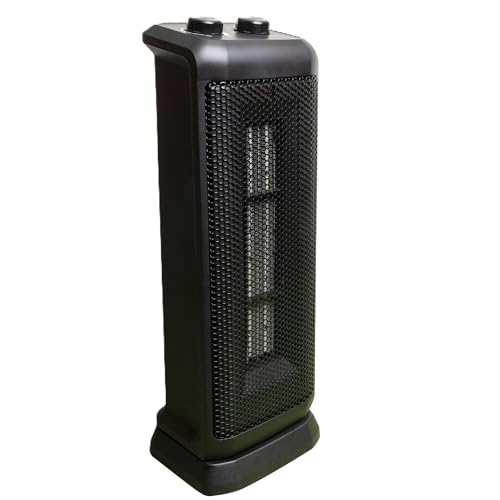
- 1500W high, 750W low, and 20W fan-only modes
- PTC ceramic heat blows warm air in 3 seconds
- Heats small to medium rooms up to 200 sq. ft.
- ETL certified with overheat protection
- 3.75 lb body with handle and 80-inch cord
Cons
- Coverage is limited to rooms up to 200 sq. ft.
- No timer or remote control mentioned
- Knob control, no thermostat range listed

Pros
- 1500W electric ceramic heater
- 70° oscillation helps spread warm air
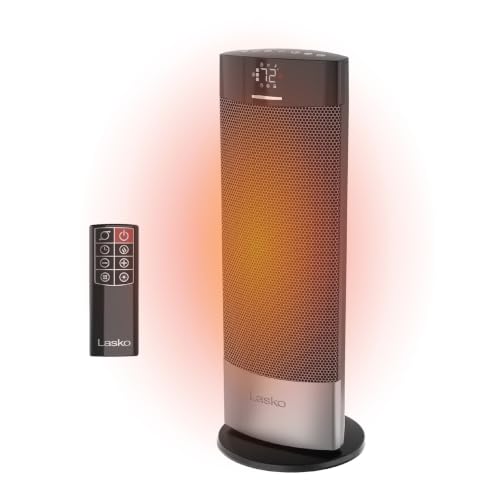
- 5 modes plus adjustable thermostat
- 12H timer and remote control
- Tip-over, overheat protection, ETL certified
Cons
- Heating coverage is not specified
- Remote needs 2 AAA batteries, not included

Pros
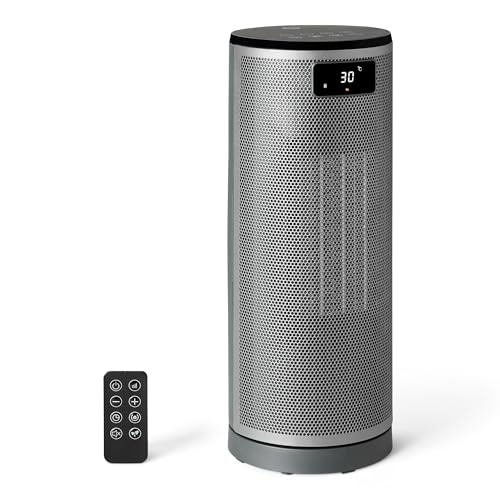
- 1500W PTC ceramic heating warms spaces up to 200 sq ft
- Operates under 35 dB for quiet bedroom or office use
- Adjustable thermostat range from 59 to 95 degrees F
- Includes remote control, LED display, and 12 hour auto off timer
- Tip over protection and lightweight 3.3 lb design for easy portability
Cons
- ECO mode allows a wide 5 to 6 degree F swing before reheating, less precise than High or Low
- IPX2 rating suits splash exposure only, not for direct water contact
- 5 foot cord length may limit placement options in larger rooms

Pros
- 1500W PTC ceramic heat with warmth in as little as 2 seconds
- 360° outlet heats spaces from 160 to 270 sq. ft.
- 41 to 95°F thermostat adjusts in 1°F increments
- 25 dB operation, 1 to 12 hour timer, and remote control
- Tip-over shutoff, overheat protection, and flame-retardant materials
Cons
- Best for rooms up to 270 sq. ft., not large open areas
- Electric space heaters can raise electricity use at high settings
- 5.21 lb weight is portable but not ultra-light
What We Looked For in Space Heaters That Use the Least Electricity
Almost every plug-in heater tops out at the same wattage, so the real savings come from low settings, thermostats and matching the heater to the room. We judged each model on how little power it needs to keep one space comfortable, and on how safely it does it.
- Heat output for the room size: Five of our six picks run at 1,500 watts on high, and one runs at only 500 watts. What matters for your bill is the lowest useful setting, since a heater that idles at a lower wattage costs less per hour. The Amazon Basics Oil-Filled Radiator offers three steps of 1,500, 1,000 and 600 watts, and its seven oil-filled fins keep giving off heat after the element cycles off. It is rated for rooms up to 144 square feet, which suits a bedroom or small office.
- Safety shutoffs and certification: Five of our six picks list tip-over protection, and three carry ETL certification. According to the U.S. Consumer Product Safety Commission, an automatic cut-off is required to turn off electric heaters if they tip over. The agency also advises choosing a heater certified by a nationally recognized testing laboratory, which is what an ETL mark means.
- Thermostat and controls: A thermostat saves power by shutting the element off once the room is warm, instead of running flat out all day. Among our picks with a listed range, settings run from 41 to 95 degrees Fahrenheit. The Dahtec Ceramic Heater pairs a built-in thermostat with a 750-watt low setting, half its 1,500-watt high. It is rated for up to 200 square feet and adds a 20-watt fan-only mode for summer.
- Noise level: A quiet heater is one you will actually leave on low overnight rather than switching to high for a quick blast. Among the fan heaters on our list, listed noise runs from 25 to 48 decibels. Our top pick has no fan at all, which makes it the quietest choice for a bedroom.
- Oscillation and heat spread: Even heat means you can set the thermostat lower and still feel warm across the room. The Qowetu 17-Inch Space Heater sweeps about 70 degrees to push 1,500 watts of warm air into corners. It also adds an adjustable thermostat plus tip-over and overheat protection, so the wider spread does not cost you safety.
- Size, weight and portability: A light heater follows you from room to room, so you only heat the space you are using. Among our picks, weights run from 1.4 pounds to 17.4 pounds. The heaviest model rolls on casters, while the lightest fits on a desk at under 6 inches tall.
We left out central furnaces and whole-house systems because they need professional installation and do not target a single room. Water heaters and heated blankets do a different job, so they are not compared here. We also excluded unvented fuel heaters without an indoor rating, since they carry a carbon monoxide risk indoors. A few other electric models came close, and they are worth a look if your needs differ.
Other Space Heaters Worth Considering
These are other space heaters we looked at but did not put on our main list.
If your room is far bigger than a home office, the Mountman 37-Inch Tower Heater is rated for up to 500 square feet, more than three times the 144-square-foot rating of our top pick. It adds 120-degree oscillation and an adjustable thermostat, but its low setting is 1,000 watts, so it saves less power in a small space.
Prefer something you can carry with one hand? The Olixis 23-Inch Space Heater weighs 4.1 pounds versus 17.4 pounds for our top pick. It runs at 1,500 watts with 70-degree oscillation, a thermostat, and tip-over and overheat protection, though it lacks the radiator’s 600-watt low step.
Along the same lines, the Jibufi Space Heater adds 70-degree oscillation and is rated for up to 200 square feet. It lists tip-over protection but no overheat protection, which our main picks cover more fully.
And if weight is the whole reason you are shopping, the Black+Decker BHDC201 comes in at 2.8 pounds versus 17.4 pounds for our top pick. It offers a 750-watt low setting and an adjustable thermostat, with tip-over and overheat protection. It narrowly missed our list because its compact fan design lacks the lingering heat of an oil-filled radiator.
FAQs
How much electricity does a 1,500-watt space heater use?
At full power, a 1,500-watt heater draws 1.5 kilowatt-hours for every hour it runs. Five of our six picks run at that wattage on high, but their low settings drop to between 600 and 750 watts. A thermostat that cycles the element off cuts actual use further.
Is a lower-wattage heater always cheaper to run?
Per hour, yes: a 500-watt model uses one third of the power of a 1,500-watt heater. It also puts out one third of the heat, so it suits a desk or small nook rather than a full room. Our picks are rated for rooms from 144 to 270 square feet, and matching that rating to your space matters more than the wattage alone.
Can I leave a space heater running overnight?
The U.S. Fire Administration advises turning space heaters off when leaving the room or going to bed. It notes that portable heater fires were only 3 percent of home heating fires in 2017 to 2019 but accounted for 41 percent of fatal ones. At least two of our picks include timers of up to 12 hours if you want warmth while falling asleep.
Where should I place a space heater?
The CDC and the Consumer Product Safety Commission both say to keep a heater at least 3 feet from drapes, furniture or bedding. The CPSC adds that it should sit on a level, hard, nonflammable surface, not on rugs or carpets. Never cover a heater, even to dry clothes.
Sources
- CPSC Offers Tips to Prevent Home Fires From Space Heaters, U.S. Consumer Product Safety Commission. Fire-safety tips and required safety features for space heaters.
- Heating Fire Safety, U.S. Fire Administration. Home heating fire statistics and prevention messages.
- Safety Guidelines: During & After a Winter Storm, Centers for Disease Control and Prevention. Winter heating safety for space heaters, kerosene heaters and carbon monoxide.



Write Your Review
No reviews yet. Be the first to share your experience!