

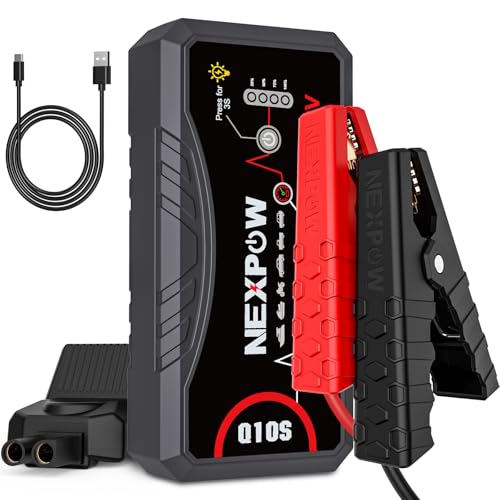
The worst time to learn your battery is dead is when the coffee is cooling in the cup holder and the school drop-off line is moving without you. 12v jump starters solve that problem by putting a battery boost in the trunk instead of depending on a passing stranger. After comparing 6 models, the NEXPOW 3000A Jump Starter stands out for its 3,000-amp peak, coverage up to 9L gas and 7L diesel engines, and 2.1-pound size. The DBPOWER 5000A Jump Starter is the alternative pick for its 5,000-amp peak.
Pros
- 3000A peak current for 12V vehicles
- Rated up to 9.0L gas and 7.0L diesel engines
- 10 protections, including spark-proof and reverse polarity
- USB1, USB2, Type-C input, and EC5 DC port
- Compact 6.3 x 3.15 x 1.57 inch body
Cons
- No built-in air compressor listed
- Wall charger is not listed in the package
- 2.1 lb weight may be noticeable in a glove box

Pros
- 5000A peak current for up to 10.0L gas and 8.0L diesel engines
- Up to 20 jump starts on a single charge
- 74Wh battery with two USB outputs, 5V/3A and 5V/2.1A
- IP65 rating and works from -4°F to 140°F
- 1.34 lb body with 1.81 x 3.79 x 7.36 in. dimensions
Cons
- No air compressor listed
- Wall charger is not listed in the package
- Requires original cable to avoid false battery readings

Pros
- 1,700 peak amps and 425 cranking amps
- 68 inch 2 AWG welding cable leads
- Heavy duty Powerjaw clamps
- Built-in 3A automatic charger
- Master ON/OFF switch
Cons
- 23 pound weight is bulky to carry
- 22 x 18 x 9 inch size needs storage space
- No USB ports or air compressor listed

Pros
- 5000A peak output for 12V vehicles
- Rated for up to 10.0L gas and 8.0L diesel engines
- Up to 40 jump starts on a full charge
- 3.0 inch LCD shows key jump starter information
- USB 5V 2.4A and USB quick charge outputs
Cons
- Recommended to jump start only above 75% battery level
- Needs recharging every 2 to 3 months for battery care
- Wait 30 seconds between jump attempts to avoid overheating


Pros
- 5000A peak current for 9.0L gas or 8.5L diesel engines
- Up to 20 jump starts from a 3-hour charge
- 54.76Wh power bank with Type-C fast charging
- 800-lumen LED with steady, strobe, and SOS modes
- Works from -4°F to 140°F
Cons
- Wall charger is not listed, only a USB-C cable
- No air compressor is listed
- Lithium jump starters need battery charge to work
What Matters Most in 12v Jump Starters
A jump starter has one job that matters more than any extra feature: it has to crank the engine when the battery cannot. For drivers, the right pick depends on engine size, where the unit will be stored, how long it can sit between charges, and how much protection the clamps provide.
- Engine coverage: We looked first at the stated gas and diesel limits because a compact sedan and a diesel pickup do not ask the same thing from a booster. Among our picks, gas coverage runs up to 10L, while diesel coverage reaches up to 8.5L. The NEXPOW 3000A Jump Starter covers up to 9L gas and 7L diesel engines with a 3,000-amp peak, which is enough headroom for many cars, trucks, motorcycles, boats, RVs, and tractors named in its specifications.
- Size and weight for vehicle storage: A jump starter that is too bulky is more likely to end up on a garage shelf than in the vehicle. The lightest listed unit is 0.86 pounds, while the heaviest specified lithium model is 2.1 pounds. The LQKDU 5000A Jump Starter pairs a 5,000-amp peak with a 0.86-pound body, giving it the strongest weight advantage among the listed models with a stated weight.
- Starts per charge and holding a charge: Starts per charge matter if the booster may serve more than one vehicle or sit through a long trip. Among our picks, stated jump counts reach up to 40 starts per full charge, while two listed models state up to 20 starts per charge. One listed model also claims an 18-month standby capacity, which is useful for drivers who do not want to think about maintenance charging every week.
- Cold-weather operating range: Cold is hard on car batteries, and AAA Oregon/Idaho says a battery loses about 35 percent of its strength at 32°F. At 0°F, that loss rises to about 60 percent, and an engine may need up to twice the normal current to start. The HPBS H50 is rated from -4°F to 140°F, and it combines that range with a 5,000-amp peak and coverage up to 10L gas and 8L diesel engines.
- Safety protections in the clamps: We gave more weight to models that spell out clamp protections because wrong connections can happen in a dark driveway. Several picks list 10 protection systems, including reverse polarity, overcurrent, overvoltage, short circuit, overcharge, over-discharge, and overheating protections. The U.S. Consumer Product Safety Commission has documented a lithium jump starter recall involving about 10,400 units, with 45 overheating or melting reports, so thermal protection is not a small detail.
- USB power bank output: A booster that can also charge a phone is more useful during a roadside delay. Among our picks, USB output specifications include 5V/2.1A, 5V/2.4A, and 5V/3A ports. One listed unit uses a 74Wh battery, which is below the Federal Aviation Administration limit of 100Wh per lithium ion battery for regular passenger carry rules.
We excluded jumper cables because they need a second running vehicle, which is exactly what you may not have in a parking lot or rural driveway. We also left out trickle chargers and maintainers because they work over hours, not seconds, and 24V semi truck boosters because they are built for commercial trucks and are heavier than most drivers need.
Other Jump Starters Worth Considering
These are other jump starters we looked at but did not put on our main list.
If keeping weight low is the priority, Gillaway 3000A Jump Starter has a 3,000-amp peak and weighs 1.2 pounds, compared with 2.1 pounds for our top pick. It also lists coverage up to 9L gas and 7L diesel engines, plus up to 50 starts per charge.
For shoppers who want a higher peak number without stepping up to the largest engine claims, BIUBLE 5000A Jump Starter lists a 5,000-amp peak versus 3,000 amps for our top pick. Its engine coverage is lower than several main-list choices, though, at up to 7L gas and 5.5L diesel.
More reserve on paper is the appeal of OXILAM 6000A Jump Starter, which lists a 6,000-amp peak and up to 60 starts per charge. It also claims support for all gas engines and diesel engines up to 12L, which is beyond the 10L gas and 8.5L diesel ceilings stated by the main picks.
And if the biggest peak rating is the whole reason you are shopping, Sharmeal 7000A Jump Starter lists a 7,000-amp peak. It also claims all gas engine coverage and diesel engines up to 12L, but it does not give a weight figure here, which makes it harder to compare for glove-box or console storage.
FAQs
How much peak current do 12v jump starters need?
Peak current should be matched to the engine size, not just the largest number on the box. Our picks range from 1,700 peak amps to 6,000 peak amps, with stated gas engine coverage reaching up to 10L.
Are lithium jump starters safe to keep in a car?
Lithium jump starters should have clear protections against reverse polarity, overheating, short circuits, and overcharge conditions. The CPSC recall involving about 10,400 units shows why clamp safety and heat protection matter.
What cold-weather rating should drivers look for?
A practical winter unit should list an operating range that reaches below freezing. Several picks state operation down to -4°F, while AAA Oregon/Idaho notes that a car battery loses about 60 percent of its power at 0°F.
Can a 12v jump starter be used as a power bank?
Many compact jump starters include USB output for phones and small devices. Among our picks, stated USB outputs include 5V/2.1A, 5V/2.4A, and 5V/3A, so charging speed and port count are worth checking before buying.
Sources
- Winter Battery Preparation, AAA Oregon/Idaho. How cold weather drains car batteries and when to replace them.
- Whistler Recalls Jump&Go Portable Jumpstart and Power Supply Units, U.S. Consumer Product Safety Commission. Recall of a lithium jump starter that could overheat.
- PackSafe: Lithium Batteries, Federal Aviation Administration. Airline rules for carrying lithium batteries and power banks.


Write Your Review
No reviews yet. Be the first to share your experience!